Every country in the world flies a rectangular or square flag. Every country except mine.
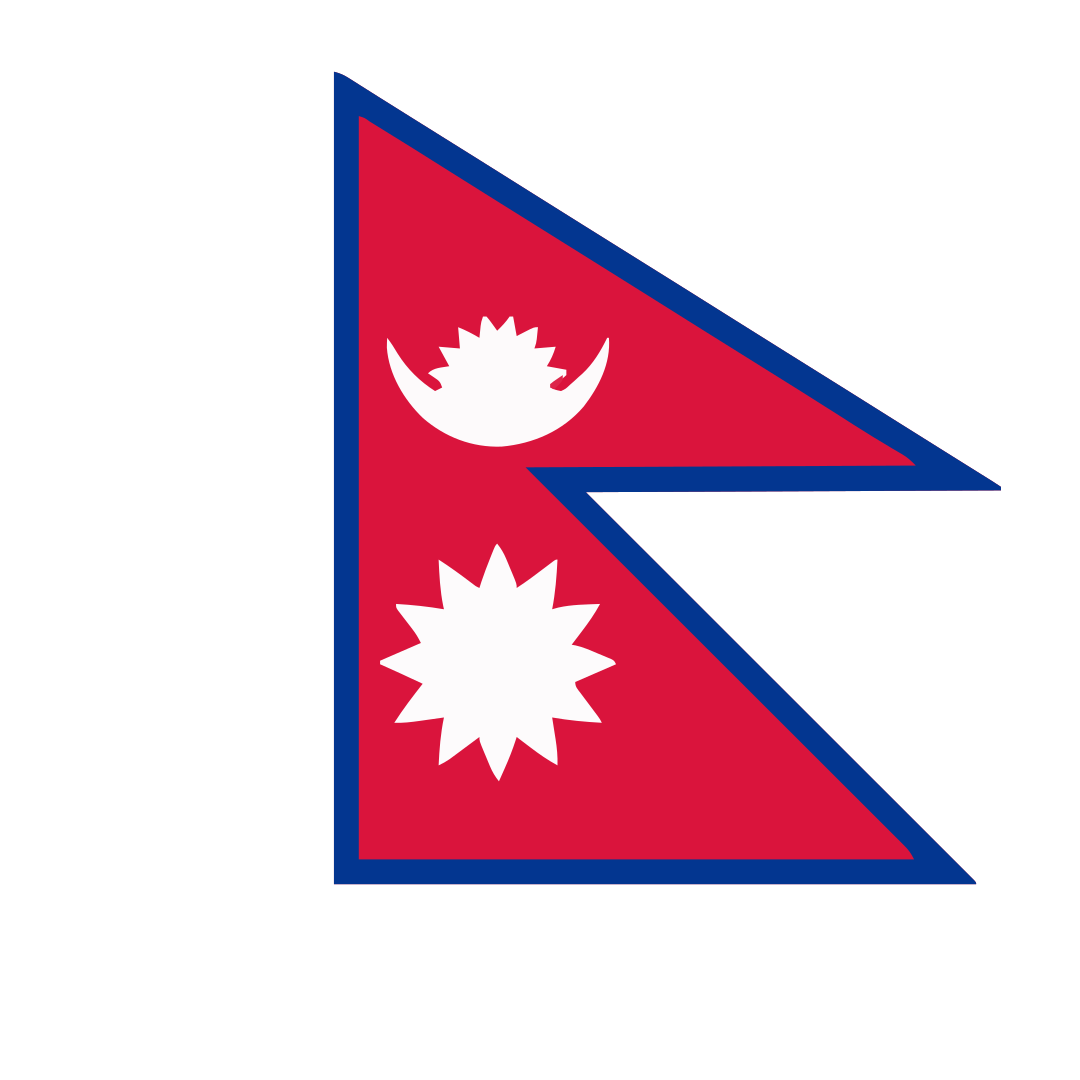
Nepal’s flag is two stacked triangles — a shape so unusual that it has its own mathematical formula written into our constitution. Foreign visitors notice it the moment they cross the border. Olympic organizers have had to redesign their flag displays because of it. Trivia hosts use it as a tiebreaker question. And yet, when I ask Nepali friends why our flag is shaped this way, even most of us can’t give the full answer.
So I’m going to give you the full answer. Not the tourist-brochure version. The real one here in Nepal Facts.
Short answer: Nepal’s flag is not rectangular because it predates the European idea that flags should be rectangular. It’s made of two triangular pennants — one for the Shah dynasty, one for the Rana family — stacked together. The mountains, the sun, the moon, the religions — those are layered meanings added over centuries. But the shape itself is older than most countries on Earth.
Now the long answer.
When most people see Nepal’s flag, they assume the shape is a modern design choice. It isn’t. The shape is the oldest thing about it.
Long before Europeans standardized flags as rectangles, kingdoms across the Indian subcontinent — Nepal included — flew triangular pennants. The triangular shape reflects the historical shape of flags used by kingdoms on the Indian subcontinent, and Nepal’s flag has been documented in use since the time of the Malla dynasty (12th to 18th century). You can still see the design today on the metal pennants installed at temple doorways throughout Kathmandu — including the Golden Gate at Bhaktapur Durbar Square, dated 1753 AD.
Here’s what most articles won’t tell you: in the colonial era, almost every other Asian country changed their flags to fit the European rectangular standard. Ethiopia’s separated red, yellow, and green pennants were merged into a horizontal triband. Other Indian subcontinent kingdoms abandoned their pennants. Nepal didn’t, because Nepal was never colonized.
One flag historian called Nepal’s flag a “living fossil” — surviving in a secluded, mountainous nation the same way unusual species survive on islands. The rest of Asia gave in. We didn’t.
That single fact — uncolonized — explains the shape more than any symbolism does.
The two triangles: not just mountains
The two triangles are usually explained as “the Himalayas.” That’s true, but incomplete. They mean several things at once, and which meaning matters most depends on who you ask.
Interpretation 1 — The Himalayas. The two triangular peaks point upward like the mountain range that defines Nepal’s geography. Eight of the world’s ten highest peaks sit on our soil.
Interpretation 2 — Two religions. The upper triangle represents Buddhism, the lower represents Hinduism — the two major faiths that have coexisted in Nepal for over 2,000 years. Lord Buddha was born here. Hindu temples cover the country. The flag honors both.
Interpretation 3 — Two ruling families. This is the version that gets left out of tourist guides. The current flag merges two triangular flags representing the Shah and Rana families, symbolizing the union of Nepal’s diverse royal branches and the end of Rana rule. The Rana family ran Nepal as hereditary prime ministers for 104 years (1846–1951). When their rule ended, the new constitution stitched their two pennants together — a political compromise dressed up as a national symbol.
Interpretation 4 — Pagoda roofs. Some scholars argue the design is inspired by the cross-section of a pagoda roof, the multi-tiered upward-curving roofs that define traditional Nepali architecture.
All four interpretations are correct. The flag is layered, like the country.
What the colors actually mean
| Element | What it represents |
|---|
| Crimson red (the field) | Bravery, and Nepal’s national flower — the rhododendron (laliguras) |
| Deep blue (the border) | Peace |
| The moon (upper triangle) | Calmness, purity, the cool climate of the Himalayas, and the Rana family who once ruled Nepal |
| The sun (lower triangle, 12 rays) | Energy, fierce resolve, the warmer southern plains, and the Shah royal family |
| Together, sun and moon | The hope that Nepal will endure as long as these celestial bodies remain in the sky |
The 12 rays of the sun are not decorative — they’re mandated. The constitution requires exactly 12
The math: a flag with its own geometry textbook
This is the part most articles skip, and it’s the most interesting.
When Nepal adopted the current flag on December 16, 1962, King Mahendra hired a mathematician to formalize how to draw it. The result is hidden in Schedule 1 of Nepal’s Constitution — twenty-four geometric construction steps that read like a math exam.
The instructions begin:
“On the lower portion of a crimson cloth, draw a line AB of the required length from left to right. From A draw a line AC perpendicular to AB making AC equal to AB plus one third AB. From AC mark off D making line AD equal to line AB. Join BD…”
And it continues for twenty more steps. To draw the flag correctly, you need a compass, a straightedge, and a steady hand. There is no shortcut.
One mathematician quoted by CNN called it “the nerdiest mathematical flag that is out there”. The sun must have exactly 12 rays. The sun and moon must be white. The border color is specified as “deep blue.” Get the geometry wrong, and the flag is technically unconstitutional.
There’s also one detail almost no foreigner knows: Nepal’s flag is the only national flag in the world that is taller than it is wide. Every other country flies a flag wider than it is tall. We don’t.
When you solve the geometric system of equations created by the constitution, the exact aspect ratio (width to height) of the flag’s bounding box is an irrational number. It is calculated using this formula:
When simplified, this gives an aspect ratio of approximately 1:1.21901033…
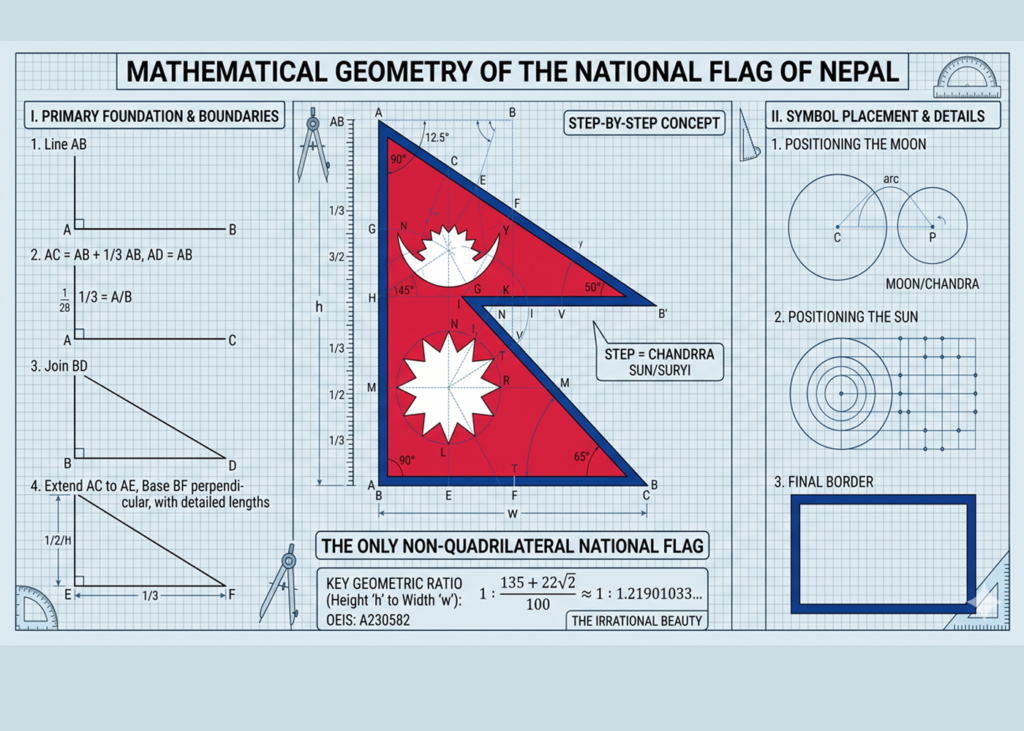
Nepal is the only country on Earth whose national flag requires you to solve complex polynomial geometry just to find its exact dimensions!
A few facts to win bar trivia with
- Nepal’s flag was officially adopted on December 16, 1962, alongside a new constitutional government.
- It is the only non-rectangular national flag currently in use anywhere in the world.
- It is the only national flag taller than it is wide.
- The exact specifications are written into Article 1, Schedule 1 of the Constitution of Nepal.
- The sun has exactly 12 rays. Not 11. Not 13.
- The flag was never redesigned for the European standard because Nepal was never colonized.
- Until 1962, the sun and moon on the flag also had stylized human faces. They were removed during the modernization.
Frequently asked questions
Q: Is Nepal really the only country with a non-rectangular flag? Yes. The Vatican and Switzerland have square flags (not rectangular), but every other national flag is a rectangle. Nepal’s two-triangle design is genuinely unique in the world.
Q: When was Nepal’s flag adopted? The current standardized version was adopted on December 16, 1962. But the basic two-pennon design has been in continuous use since at least the Malla dynasty (12th–18th century).
Q: Why does the flag have a sun and a moon? The sun and moon symbolize the hope that Nepal will endure as long as those celestial bodies exist. They also originally represented the two ruling families — the Shahs and the Ranas.
Q: Who designed Nepal’s flag? The basic design is ancient and has no single designer. The modern standardized version was formalized in 1962 by a mathematician hired by King Mahendra, whose name is not consistently recorded in official sources.
Q: Can I buy a Nepali flag in Kathmandu? Yes, easily — Thamel has many shops selling flags in every size. Just make sure you’re buying one with the correct constitutional proportions. Cheap tourist versions sometimes get the math wrong.
Q: Is it illegal to display the Nepali flag incorrectly? Disrespecting the national flag is punishable under Nepali law, but accidental incorrect display (wrong proportions, wrong number of sun rays) is generally treated as ignorance rather than offense. Just don’t drag it on the ground or use it as decoration on clothing — both are taken seriously.
Free Nepal Flag Downloads:




 Nepalfacts 05 minutes read 297 views