Comments Off on Dashain Festival in Nepal: Meaning, Rituals & Traditions
Key Takeaways
Dashain is Nepal’s largest festival, a 15-day Hindu celebration marking the goddess Durga’s victory over the demon Mahishasura.
The festival runs from Ghatasthapana, when barley seeds are planted, to Kojagrat Purnima, the closing full moon night, with Vijaya Dashami as the main Tika day.
Tika and Jamara, applied by elders to younger relatives, symbolize the transfer of blessings and protection within families.
Animal sacrifice occurs during Dashain in many Hindu households and temples, though vegetarian-only celebrations are also common and equally valid.
Dashain dates shift yearly with the lunar calendar, so travelers should confirm exact 2025 and 2026 dates through the Nepal Tourism Board before planning a visit.
Kites bob above Kathmandu’s rooftops, marigold garlands hang across doorways, and buses out of the capital fill up for weeks as people head home. This is Dashain, the biggest and most anticipated festival on the Nepali calendar. The Dashain festival Nepal celebrates each year in autumn is a fifteen-day Hindu celebration marking the goddess Durga’s victory over evil, and it is when families reunite, elders bless the young, and entire cities briefly slow down.
Dashain is celebrated across Nepal by Hindus and by many Buddhists, indigenous communities, and even some Christians who join relatives for the family gatherings. It falls in the Nepali months of Ashwin or Kartik, roughly September or October, based on the lunar calendar, so exact dates shift every year. Understanding what happens day by day, and how to behave respectfully as a guest during this time, makes the experience far richer for any traveler in the country.
What Is Dashain and Why Do Nepalis Celebrate It?
Dashain is Nepal’s most important national festival, a fifteen-day period honoring the goddess Durga’s triumph over the buffalo demon Mahishasura and celebrating the victory of good over evil. It functions as a religious observance, a family reunion, and a national holiday, with schools, offices, and many businesses closing for several days around the main Tika dates.
For most Nepalis, Dashain is less about theology and more about home. People working in Kathmandu, in the Gulf, or elsewhere abroad try to return to their ancestral villages. The festival reinforces family hierarchy and respect for elders, since the central ritual involves younger relatives receiving blessings from older ones. It is also a significant economic event: new clothes, bonuses, livestock markets, and travel demand all rise in the weeks beforehand.
The Mythology Behind Dashain: Goddess Durga’s Victory Over Demons
The mythology behind Dashain centers on the goddess Durga defeating Mahishasura, a shape-shifting demon said to have grown powerful enough to threaten gods and humans alike. According to the Devi Mahatmya, a Hindu scripture central to Durga worship, the goddess battled the demon for nine days and nights before finally defeating him on the tenth day, an event honored across Nepal and parts of India.
This nine-day battle is remembered during Nepal’s Nawa Ratri, or “nine nights,” when different manifestations of the goddess are worshipped in temples such as Kathmandu’s Taleju Temple, part of the wider goddess-worship tradition that also includes Nepal’s Kumari, the living goddess. The tenth day, called Vijaya Dashami, marks Durga’s final victory and gives Dashain its name and its most sacred ritual: Tika.
Day by Day: A Complete Timeline of Dashain’s 15 Days
Dashain unfolds over fifteen days, from Ghatasthapana, when a ritual sprouting of barley seeds begins, to Kojagrat Purnima, the final full moon night. Each phase carries its own ritual meaning, moving from planting and worship toward blessing and closure.
Day 1, Ghatasthapana: Families plant barley seeds in a sand-filled container kept in a dark corner of the house; this becomes the Jamara used later for Tika.
Days 2–6: Quieter days of prayer and preparation, with the goddess worshipped in various forms.
Day 7, Fulpati: Sacred flowers, sugarcane, and banana stalks are carried in procession to Kathmandu’s Hanuman Dhoka palace complex.
Day 8, Maha Ashtami: A day of intense worship of Durga; animal sacrifices often take place at temples and homes.
Day 9, Maha Nawami: Sacrifices continue, and this day also honors tools, vehicles, and machinery in a ritual called Vishwakarma Puja.
Day 10, Vijaya Dashami: The main Tika and Jamara day, when elders bless younger family members.
Days 11–14: Families continue visiting relatives to exchange Tika, often traveling between multiple households and villages.
Day 15, Kojagrat Purnima: The festival closes on a full moon night, sometimes marked with card games and family gatherings late into the night.
This structure, from Ghatasthapana to Kojagrat Purnima, is what gives Dashain its “fifteen days” reputation, though in practice most workplaces close for about a week around the main Tika days.
Tika and Jamara: The Meaning Behind Nepal’s Most Sacred Blessing
Tika and Jamara are the central blessing rituals of Dashain, performed on Vijaya Dashami, in which elders apply a mixture of rice, yogurt, and vermilion powder to a younger person’s forehead while placing yellow Jamara shoots in their hair. The ritual symbolizes the transfer of blessings, protection, and good fortune from elder to younger family member.
Jamara refers to the barley shoots planted on Ghatasthapana, grown in darkness for nine days so they emerge pale yellow rather than green. Receiving Tika generally follows an order of seniority within a family, starting with grandparents and moving down, and often includes a small gift of money. Many people travel long distances during these final days specifically to receive Tika from a grandparent or elder relative, though families separated by distance sometimes exchange blessings by phone or video call instead.
Kite Flying, Swings (Ping) and Other Dashain Traditions
Kite flying during Dashain traditionally carries a symbolic message to Indra, the Hindu god of rain, asking him to hold back the clouds so the festival’s clear autumn skies can continue. Colorful kites, locally called changa, fill the sky over Kathmandu Valley and other towns for much of the festival period.
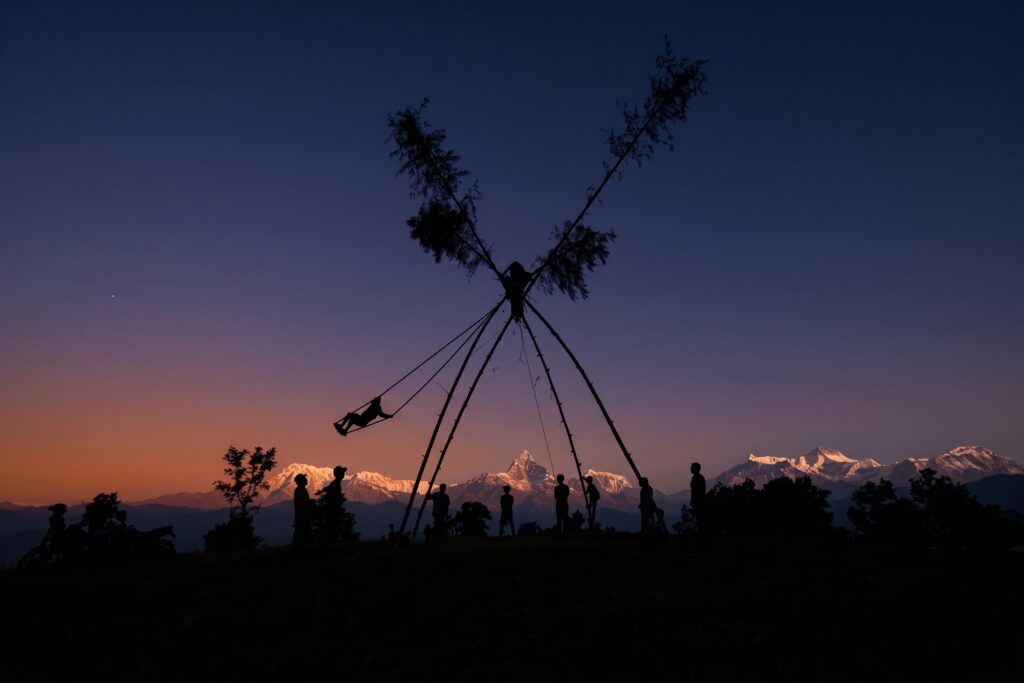
Alongside kites, communities build large bamboo swings called ping, tall enough for several people to stand on at once. Swinging on the ping is considered auspicious and is especially popular with children and teenagers in villages and neighborhoods. Other common traditions include:
Card games among family and friends, widely tolerated specifically during this period
Wearing new clothes, often the year’s main clothing purchase for many families
Cleaning and decorating homes before the main Tika days
Visiting extended family and neighbors to exchange Tika and blessings
These customs, alongside broader traditions covered in this overview of fascinating facts about Nepali culture, show how Dashain blends devotion with genuine festivity.
The Truth About Animal Sacrifice During Dashain
Animal sacrifice is part of Dashain for many Hindu families and temples in Nepal, particularly on Maha Ashtami and Maha Nawami, when goats, buffaloes, ducks, or chickens are offered to the goddess Durga and later cooked and eaten as part of the family feast. The practice reflects a belief that the offering pleases the goddess and brings protection to the household.
This topic is genuinely sensitive and worth addressing honestly rather than glossing over it. Not every Nepali family practices animal sacrifice; many, including numerous Buddhist households and reform-minded Hindu families, mark Dashain with vegetarian offerings only and still fully celebrate Tika and Jamara. Large public sacrifices at certain temples and government or military sites can be intense for visitors unaccustomed to them. Travelers who prefer not to witness this can simply avoid temple courtyards on Ashtami and Nawami mornings while still enjoying the rest of the festival’s rituals and gatherings.
What to Eat During Dashain: Festival Foods and Family Feasts
Dashain meals center on freshly prepared meat, especially goat, alongside rice, lentils, and seasonal vegetables shared during large family gatherings. Meat from a sacrifice is typically cooked the same day and served to the extended family, with many relatives often eating together over the festival period.
Sel roti, a ring-shaped sweet rice bread fried until golden, appears in many households during Dashain and Tihar, the festival that follows a few weeks later. Homemade alcohol, particularly in rural communities, and sweets such as laddu and various milk-based desserts also feature heavily. For a broader sense of the country’s culinary range beyond festival specials, this guide to traditional dishes to try in Nepal is a useful companion.
A Traveler’s Guide: What to Expect If You’re in Nepal During Dashain
Travelers in Nepal during Dashain should expect closed shops, quieter cities, and fewer public buses, since most Nepalis are traveling to or staying in their family homes rather than working. Kathmandu and Pokhara can feel notably calmer than usual, while highways toward the countryside get heavily congested with people heading home.
Dashain often overlaps with Nepal’s popular autumn trekking season in regions such as the Annapurna Conservation Area in Gandaki Province or the Everest region in Solukhumbu District, Koshi Province. Trekking permits, TIMS cards, and licensed guides are still required as usual, arranged through the Department of Immigration or the Department of National Parks and Wildlife Conservation as applicable, and altitude sickness prevention, gradual ascent, proper hydration, and awareness of symptoms, applies regardless of the festival calendar. A short etiquette guide helps foreign visitors join in respectfully:
Accept Tika graciously if a Nepali host offers it, but never expect it as a stranger
Dress modestly when visiting temples, especially during Ashtami and Nawami rituals
Ask before photographing sacrifice rituals; some families and temples prefer privacy
Expect limited transport options and book intercity travel well ahead of Dashami
Confirm opening hours of banks, government offices, and trekking agencies, since many close for several days around the main Tika date
Feature
Dashain
Tihar (Diwali)
Main deity
Goddess Durga
Goddess Lakshmi
Core ritual
Tika and Jamara blessing
Light offerings and animal worship days
Typical timing
Ashwin–Kartik (Sept–Oct)
Kartik (Oct–Nov)
Duration
About 15 days
About 5 days
Signature symbol
Kites and swings
Oil lamps and rangoli
Because exact dates depend on the lunar calendar, always check the current year’s dates through the Nepal Tourism Board or a reliable Nepali calendar closer to your travel time rather than relying on a fixed date.
Celebrating Dashain, Wherever You Are
Dashain rewards anyone willing to look past the surface, from the quiet symbolism of barley shoots grown in darkness to the joyful noise of kites racing across an autumn sky. Whether you are Nepali, part of the diaspora returning home, or a traveler experiencing it for the first time, the festival’s real heart lies in family, gratitude, and renewal. Share your own Dashain memories or questions in the comments, and consider planning a visit to Nepal around this season to see it firsthand.
Frequently Asked Questions
What is Dashain and why is it celebrated in Nepal?
Dashain is Nepal’s biggest Hindu festival, celebrating the goddess Durga’s victory over the demon Mahishasura. It is celebrated as a symbol of good triumphing over evil and as a major family reunion, with schools, offices, and businesses closing for about a week around the main Tika days.
How long does Dashain last and what happens each day?
Dashain lasts fifteen days, from Ghatasthapana, when barley seeds are planted, to Kojagrat Purnima, the closing full moon night. Key days include Fulpati on day seven, sacrifice-focused Ashtami and Nawami, and Vijaya Dashami on day ten, when families exchange the main Tika blessing.
What is Tika and Jamara in Dashain?
Tika is a mixture of rice, yogurt, and vermilion powder applied to the forehead by an elder, paired with Jamara, the pale yellow barley shoots placed in the hair. Together they symbolize an elder passing blessings, protection, and good fortune to a younger family member.
Why do Nepalis fly kites during Dashain?
Kite flying during Dashain traditionally sends a symbolic message to Indra, the Hindu god of rain, asking him to clear the skies. It has also become a popular seasonal pastime, with colorful kites filling the sky over Kathmandu Valley and other towns.
Is animal sacrifice part of Dashain, and why?
Yes, many Hindu families and temples in Nepal sacrifice goats, buffaloes, or poultry on Maha Ashtami and Maha Nawami as offerings to the goddess Durga, later cooking and eating the meat. Not all families practice this, and some celebrate with vegetarian offerings instead.
Can tourists witness or join Dashain celebrations in Nepal?
Tourists can often witness Dashain celebrations respectfully, including kite flying, swings, and family gatherings, though they should not expect to receive Tika unless personally invited by a host. Temple sacrifice rituals on Ashtami and Nawami can be intense, so ask locals what to expect before attending.
When is Dashain celebrated in 2025 and 2026?
Dashain follows the lunar calendar, so its dates shift each year, typically falling in September or October. For confirmed 2025 and 2026 dates, check an official Nepali calendar or the Nepal Tourism Board closer to your travel dates.


 Nepalfacts 06 minutes read 204 views