Comments Off on 20 Traditional Dishes You Should Try in Nepal
Most visitors eat momo and dal bhat for two weeks and fly home thinking they've tasted Nepal. They've tasted about a tenth of it.
Nepali food changes completely as you move across the country. The Terai plains cook like northern India. The Kathmandu Valley has a Newar cuisine with dishes you will not find anywhere else on Earth. The high Himalaya cooks like Tibet, because for most of history it traded with Tibet. Three distinct food cultures inside a country roughly the size of Greece.
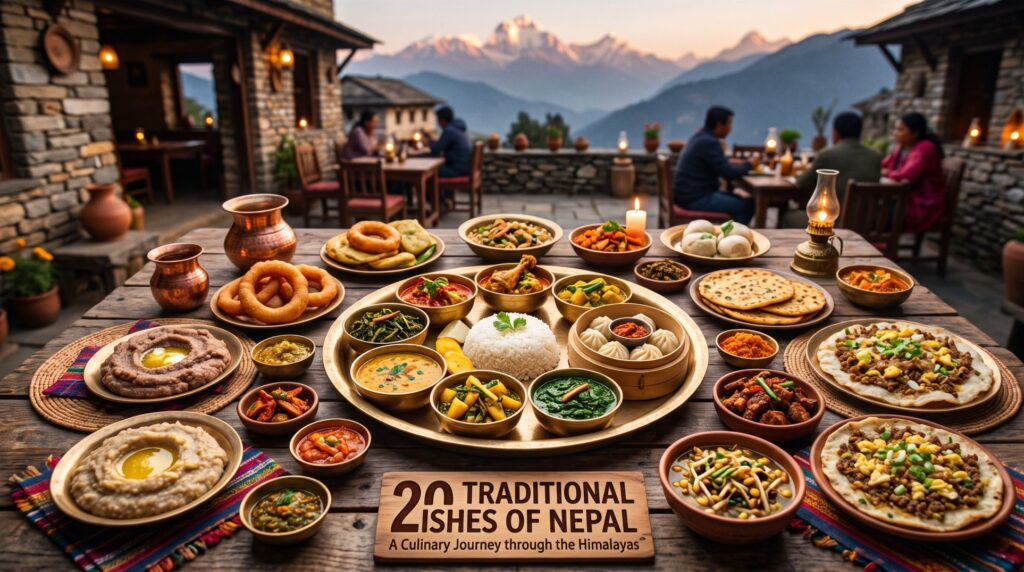
This guide covers 20 dishes worth going out of your way for, grouped by where they actually come from — with what each one tastes like, where to find it, and how to order it without guessing.
Written in Kathmandu · Last updated: [DATE]
Everyday Nepali food: what people actually eat
Start here. These six are the backbone of the national diet, eaten in some form by nearly every household in the country.
1
Dal bhat tarkari दाल भात तरकारी
Steamed rice, lentil soup, a seasonal vegetable curry, pickle, and often a leafy green and curd. Most Nepalis eat it twice a day, every day. The lentils are poured over the rice and mixed by hand, and the whole plate is designed to be eaten in combinations rather than course by course.
It is far better than its reputation suggests. A good dal bhat has four or five distinct things happening on one plate, and the pickle — achar — is where the cook shows off. Ask for extra.
The refill rule: in trekking lodges and most local bhojanalaya, dal bhat comes with free refills of rice, dal and vegetables. Nobody will offer. You hold your plate up slightly and someone comes round with the pot. This is why trekkers live on it.
Where: anywhere. For the best version, eat at a local bhojanalaya rather than a tourist restaurant.
2
Dhido ढिँडो
A thick, warm porridge of buckwheat or millet flour, stirred over heat until it comes together into a dense, smooth mass. It is served in a mound alongside curry, gundruk soup and pickle.
Dhido is not chewed. You pinch off a piece, roll it into a ball with your fingers, dip it and swallow. It was the staple food of the hills before cheap rice reached the villages, and it has come back into fashion — partly out of nostalgia, partly because it is genuinely better for you than white rice.
Where: Thakali and traditional Nepali restaurants in Kathmandu and Pokhara; standard in mid-hill villages.
3
Gundruk and sinki गुन्द्रुक / सिन्की
Nepal's great preservation trick. Leafy greens — mustard, radish or cauliflower leaves — are wilted, packed tightly into an airtight container and left to ferment for a couple of weeks, then sun-dried. Sinki is the same process using radish taproots.
The result is sour, funky and deeply savoury, rehydrated into a thin soup or fried into a pickle. It carried Nepali hill families through winters with no fresh vegetables for centuries. If you like kimchi or sauerkraut, you will like gundruk. If you don't, you won't — it does not compromise.
Where: part of most Nepali thali sets; ask for gundruk ko jhol (soup) or gundruk sadeko (pickled).
4
Aloo tama आलु तामा
Potato and fermented bamboo shoot in a turmeric-yellow broth, usually with black-eyed peas. The bamboo shoot is the point: fermenting it turns it sharply sour, and that sourness cuts through the starch of the potatoes.
This is a comfort dish, eaten with rice, and one of the clearest examples of how Nepali cooking uses fermentation where Indian cooking would use tamarind or tomato.
Where: Nepali restaurants everywhere; a standard item in a Newari or hill thali.
5
Momo मम:
Steamed dumplings, filled with buffalo, chicken, vegetables or paneer, served with a tomato-and-sesame dipping sauce called achar. Nepal's most-eaten snack by a wide margin, and the single most competitive food business in Kathmandu.
Worth knowing the variants: kothey are pan-fried on one side, C-momo are fried then tossed in a chilli sauce, jhol momo arrive swimming in a thin spiced sesame broth, and open momo are pinched into a cup shape with the filling exposed. Jhol momo is the one to order if you only try one.
Where: everywhere. Buff momo at a busy local shop will beat a hotel version every time.
6
Sel roti सेल रोटी
A ring of fermented rice-flour batter, poured in a circle into hot oil and fried until the outside is crisp and the inside stays soft and slightly chewy. Faintly sweet, faintly sour from the ferment, and nothing like a doughnut despite looking like one.
Sel roti is festival food, made in quantity for Tihar and Dashain, eaten with yoghurt or vegetable curry. Watching someone pour a perfect ring freehand into oil is a skill worth stopping for.
Where: street stalls and sweet shops year-round; everywhere at once during Tihar, usually October or November.
Newar food of the Kathmandu Valley
The Newars are the indigenous people of the Kathmandu Valley, and their cuisine is the most elaborate in Nepal — built around feasts, festivals and a long tradition of eating in a particular order. Several of these dishes exist nowhere else in the world. This section is the reason to eat in Kathmandu rather than just pass through it.
7
Samay baji समय बजी
The ceremonial Newar platter, and the best single introduction to the cuisine. Beaten rice forms the base, ringed by spiced grilled meat, black soybeans, ginger, garlic, a fried or boiled egg, bara, a wedge of bamboo shoot, greens and a fierce pickle.
Each element is a separate preparation. You eat them in combinations, with the beaten rice absorbing everything. It is served at almost every Newar religious occasion and is traditionally accompanied by aila, the home-distilled rice spirit.
Where: Newari restaurants in Kathmandu, Patan and Bhaktapur. Order it for two people minimum.
8
Bara वा:
A thick savoury pancake of ground black lentil, fried on a flat pan. Plain, or with a beaten egg or minced meat pressed into the top while it cooks. Crisp at the edges, soft and almost custardy in the middle.
This is a breakfast and snack food, and a very good vegetarian option when made plain.
Where: Newari restaurants; small shops around Patan Durbar Square do it best.
9
Chatamari चतांमरि
A thin, lacy crepe of rice flour, cooked on a flat pan with toppings scattered across the surface — minced meat, egg, spring onion, sometimes just a sprinkle of spice. It gets called "Newari pizza" on tourist menus, which does it no favours; it is lighter, more delicate and a completely different thing.
Where: Newari restaurants across the valley.
10
Choila छोयला
Grilled meat — traditionally buffalo — chopped and tossed while still warm with mustard oil, raw garlic, ginger, chilli, fenugreek and a lot of Timur, the Nepali Sichuan pepper that numbs the lips slightly.
Fiery, smoky and completely distinctive. Timur is the flavour most visitors cannot place and go home craving. Ask for haku choila for the dark, heavily spiced version.
Where: anywhere Newari food is served; a standard part of samay baji.
11
Yomari योमरि
A fish-shaped parcel of steamed rice flour, filled with chaku — molten molasses — and sesame. You bite the pointed end and the hot syrup runs out.
Yomari is tied to Yomari Punhi, the full moon festival in December marking the end of the rice harvest. It is made at other times now, but eating it in season, in Bhaktapur, on a cold December evening, is a genuinely different experience.
Where: Newari sweet shops in Bhaktapur and Patan; most abundant in December.
12
Kwati क्वाँटी
A soup of nine different sprouted beans, simmered with ginger and spices. Thick, earthy and substantial.
It is eaten on Janai Purnima in the monsoon, when the traditional logic is that a heavy, warming, protein-dense soup is what the body needs in the wet season. The beans are soaked and sprouted for days beforehand.
Where: Newari restaurants; universally available around Janai Purnima in August.
13
Juju dhau जुजु धौ
"King curd" — the yoghurt of Bhaktapur, set in unglazed clay pots. Buffalo milk is boiled down with sugar and a little spice, then poured into the porous clay, which draws out moisture as it sets. The result is thick enough to hold a spoon upright, with a clean caramel note.
It holds a Nepali geographical indication, which means the name legally belongs to Bhaktapur. It is the best single reason to make the trip out there hungry.
Where: Bhaktapur, from shops around the Durbar Square area. Eat it from the clay pot.
Terai and eastern hills
Nepal's southern plains hold roughly half the population, and the food here shares its roots with Bihar and Uttar Pradesh across the border — while the eastern hills contribute the country's best grilled meat.
14
Sekuwa सेकुवा
Meat marinated in ginger, garlic, Timur and mustard oil, then grilled over open wood or charcoal. Goat, pork, chicken or buffalo. No sauce, no disguise — it depends entirely on the marinade and the fire.
Bhojpure sekuwa, from Bhojpur in the eastern hills, is the style everyone name-checks, and Kathmandu is full of places claiming it. It is eaten as an evening snack with beaten rice and a cold beer.
Where: sekuwa corners across Kathmandu, especially in the evening. Follow the smoke.
15
Ghonghi घोंघी
River snails, slow-cooked in a thick, heavily spiced gravy, eaten by sucking the meat straight out of the shell. A Tharu speciality from the western Terai and one of the most distinctive things you can eat in Nepal.
Adventurous, genuinely delicious, and almost entirely absent from tourist menus — which is precisely why it is worth seeking out if you are in Chitwan or Bardiya.
Where: Tharu villages and local restaurants around Chitwan, Bardiya and Dang.
16
Dhikri ढिक्री
Rice flour shaped by hand into small logs, spirals or fish forms and steamed. Plain, mild and slightly chewy, eaten with a sharp chutney of sesame or chilli — the chutney does the work.
Dhikri is central to Tharu festivals, particularly Maghi, the Tharu new year in January. The shaping is done by hand and each family has its own forms.
Where: Tharu homestays and cultural programmes in the Terai. A homestay is the honest way to eat it.
Himalayan and Thakali food
North of the hills, the cooking turns Tibetan: more wheat and barley, less rice, more butter, more soup. The Thakali people of the Kali Gandaki valley sat on the salt trade route between Tibet and India for centuries, and their food absorbed both ends of it.
17
Thakali khana set थकाली खाना सेट
The refined version of dal bhat, and for many Nepalis the best meal in the country. Rice or dhido, a black lentil dal cooked long and thick, meat or vegetable curry, sauteed greens, fermented pickle, a soybean or bean side, and a Timur-heavy chutney — all served in gleaming brass.
What separates it from ordinary dal bhat is precision. The dal is richer, the pickles are made in-house, and the balance between the items is deliberate. If you eat one sit-down meal in Pokhara, make it this.
Where: Thakali restaurants throughout Kathmandu and Pokhara; the original along the Annapurna Circuit around Marpha and Tukuche.
18
Thukpa थुक्पा
Noodle soup in a clear, gingery broth with vegetables and usually meat. Tibetan in origin, standard across the Himalayan districts and on every trekking lodge menu in the country.
At altitude, hot liquid matters more than you expect. Thukpa hydrates, warms and feeds you at once, which is why experienced trekkers order it over fried food above 3,500 m.
Where: every teahouse on every trek; Tibetan restaurants in Boudha, Kathmandu.
19
Chhurpi छुर्पी
Hard cheese made from yak or chauri milk, pressed and dried until it is close to the density of wood. You do not chew it — you park a piece in your cheek and let it soften over twenty minutes or more, releasing a smoky, sour, intensely savoury flavour.
Herders carry it on long days because it keeps almost indefinitely. A soft fresh version also exists and is cooked into curries.
Where: trekking lodges, and shops in Boudha and Thamel. Buy the hard kind for the trail.
20
Tongba तोङ्बा
Not a dish but a ritual. Fermented millet is packed into a wooden vessel, topped with hot water and drunk through a narrow bamboo straw with a filter at the bottom. You refill it with hot water several times as you go; the drink starts strong and fades over an hour.
It belongs to the Limbu people of eastern Nepal and is the perfect thing on a cold evening at altitude. Warm, mildly alcoholic, and designed to be shared slowly.
Where: eastern Nepal, Ilam and the Kanchenjunga region; Newari and Himalayan bars in Kathmandu.
What food costs in Nepal
Indicative ranges for Kathmandu and Pokhara, in Nepali rupees. Prices rise steeply with altitude on trekking routes — every item has to be carried or flown in.
Dish
Local eatery
Tourist restaurant
Dal bhat (with refills)
Rs 150–300
Rs 500–900
Momo, 10 pieces
Rs 120–250
Rs 350–600
Thakali khana set
Rs 350–550
Rs 700–1,200
Samay baji, for two
Rs 400–700
Rs 900–1,500
Sekuwa, per plate
Rs 200–400
Rs 500–800
Juju dhau, one pot
Rs 60–120
—
Indicative ranges as of 14 Sept 2026. We re-check these annually. Trekking route prices are substantially higher — see our guide to food on the Everest Base Camp trek.
Eating vegetarian and vegan in Nepal
Nepal is one of the easier countries in Asia for vegetarians. A large share of the population eats vegetarian for religious reasons, every restaurant understands the concept, and the default dal bhat is vegetarian unless you add meat.
Vegan needs slightly more care. Dairy is everywhere — ghee in the dal, curd on the side, milk in the tea. The useful phrases are malai masu mildaina (I don't eat meat) and dudh ra dahi pani mildaina (no milk or curd either). Ask whether the dal is cooked with ghiu; often it is, and often they will make it without.
Reliably vegan from this list: dhido, gundruk, aloo tama, plain bara, dhikri, kwati and most vegetable thukpa. Ask about the broth on thukpa.
Eating safely without missing out
The usual advice is to avoid street food entirely, which would mean skipping most of what makes eating here worthwhile. A more useful approach:
Go where it's busy. High turnover means food that has not been sitting. A crowded momo shop at 1pm is safer than an empty restaurant with a laminated menu.
Prefer freshly cooked and hot. Momo straight from the steamer, sekuwa off the grill, sel roti out of the oil. Avoid anything lukewarm that has been standing in a display.
Be careful with raw preparations early on. Some pickles and sadeko salads are served raw. They are delicious, but give your system a few days first.
Drink filtered or treated water. Not tap. This matters far more than which restaurant you pick.
Meat on Saturdays. Saturday is the weekly holiday, butchers are busy, and meat moves fast. Late in the week at a quiet place is the riskier combination.
Quick answers
What is the national dish of Nepal?
Dal bhat tarkari — steamed rice, lentil soup, vegetable curry and pickle. Most Nepalis eat it twice a day, and in lodges it comes with free refills.
What food is unique to Nepal?
The Newar cuisine of the Kathmandu Valley. Dishes like yomari, chatamari, bara, kwati and samay baji exist nowhere else in the world.
Is Nepali food the same as Indian food?
No. Nepali cooking uses far less cream and tomato, leans heavily on fermentation (gundruk, bamboo shoot, chhurpi) and uses Timur, a numbing Sichuan-style pepper not common in Indian cooking.
Is Nepali food spicy?
Moderately. The heat usually sits in the pickle rather than the main dish, so you control it. Choila and C-momo are the genuinely hot ones.
What should I eat first in Nepal?
Jhol momo on day one, a Thakali khana set on day two, and samay baji once you have found a proper Newari restaurant.
Frequently asked questions
What is Timur and why does everything taste of it?
Timur is Nepali Sichuan pepper, harvested in the hills. It is not hot — it produces a tingling numbness on the lips and tongue. It appears in choila, sekuwa marinades, momo achar and Thakali chutney, and it is the flavour most visitors cannot identify and go home missing.
Why is buffalo meat so common in Nepal?
Cow slaughter is prohibited in Nepal, so buffalo — buff — fills the role beef would elsewhere. It is the default in momo, choila and sekuwa. It is leaner and slightly gamier than beef, and holds up well to strong spicing.
Can I get a cooking class in Kathmandu?
Yes, and momo classes are widely available in Thamel and Patan. If you want something more interesting, look for a Newari cooking class instead — fewer places offer it, and you will learn preparations you cannot recreate from a recipe site.
What do Nepalis eat for breakfast?
Often not what visitors expect. The traditional pattern is a light morning snack with tea, then a full dal bhat around 9 or 10am, and a second dal bhat in the evening, with a snack called khaja in the afternoon. Hotel breakfasts are a tourist convention, not a Nepali one.
How much should I budget for food per day?
Eating at local places, around Rs 800–1,500 a day covers three meals comfortably. Eating in tourist restaurants in Thamel or Lakeside, budget Rs 2,500–4,000. On trek, expect considerably more as altitude rises.
Planning a trip to Nepal?
Our free 29-page Nepal travel guide covers visas, seasons, budgets, trekking permits, altitude safety and culture — everything you need before you book.




 Nepalfacts 05 minutes read 203 views