airports nepal list
Airports in Nepal: The Complete Tourist Guide (2026 Updated) Nepal has 55 airports in total, but as a tourist, […]
 Nepalfacts 10 minutes read 59 views
Ask most travelers who the Sherpa people are, and you will likely hear some version of “the guys who carry gear on Everest.” That answer is incomplete and a little unfair. Sherpas are a distinct ethnic group with Tibetan roots, their own language, centuries-old Buddhist traditions, and village life that has little to do with mountaineering season. Sherpa people traditions span religion, dress, marriage customs, and festivals that have shaped the Khumbu region of Solukhumbu District in Nepal’s Province No. 1 for generations.
This article looks at Sherpa identity beyond the climbing stereotype — where they came from, how they worship, what they wear, how they marry, and why the “Sherpa” name gets confused with a job title. The mountaineering story is part of the picture, but it is only one chapter.
The Sherpa people are an ethnic group of Tibetan origin who migrated into the high valleys of northeastern Nepal several centuries ago, with most historians placing the main migration period several hundred years in the past. They settled primarily in the Solukhumbu District, in the shadow of Mount Everest, which they call Chomolungma.
The word “Sherpa” itself comes from the Tibetan words shar (east) and pa (people), meaning “people from the east.” This reflects their migration route from the Kham region of eastern Tibet, across high Himalayan passes, into what is now Nepal. Over time, Sherpa communities also settled in Rolwaling, Helambu, and parts of Darjeeling in India, though Solukhumbu remains the cultural heartland.
Sherpas speak their own language, Sherpa or Sherpali, which is related to Tibetan dialects but distinct enough that many younger Sherpas today also learn Nepali and English for trade and tourism. Nepal is home to well over a hundred languages, and Sherpa is one of the many that make up the country’s linguistic diversity, a topic explored further in this breakdown of how many languages Nepal actually speaks.
Sherpa is primarily an ethnic identity, not a profession, even though the word is often used informally in English to mean “mountain guide” or “porter.” This overlooks the fact that most Sherpas work as farmers, traders, teachers, monks, lodge owners, or professionals in fields unrelated to climbing.
Because expedition companies historically hired local Sherpa men as high-altitude guides and load carriers, the English-speaking world began using “sherpa” (lowercase) as a generic term for any mountain guide, regardless of ethnicity. This usage has even spread into politics and business, where a “sherpa” now refers to a negotiator who prepares the ground for a leader at summit meetings — a borrowed metaphor that has nothing to do with the actual Sherpa people.
Understanding this distinction matters because it restores the Sherpa people to their full identity — a community with its own homeland, religion, and customs — rather than reducing them to a job description.
Sherpas practice Tibetan Buddhism, specifically the Nyingma school, which shapes daily routines, village layout, and the calendar of festivals. Prayer flags, mani walls carved with sacred mantras, and chortens (stupas) mark the trails throughout the Khumbu region, reminding travelers that this is sacred ground long before it became a trekking destination.
Monasteries, known as gompas, serve as spiritual and social centers. Tengboche Monastery, perched above the Dudh Koshi valley, is the most famous in the region and hosts monks who perform daily prayers, seasonal rituals, and teachings. Many Sherpa families have historically sent at least one son to train as a monk, a tradition that continues alongside modern schooling, though participation varies by family today.
Daily life carries small rituals most visitors barely notice: spinning a prayer wheel while passing a mani wall, walking clockwise around religious structures, or offering juniper incense at a household shrine. These practices are not performed for tourists; they are woven into ordinary routines of farming, trading, and traveling between villages.
Traditional Sherpa clothing reflects both Tibetan heritage and the practical needs of high-altitude life, built around warm wool, layered robes, and sturdy boots suited to cold mountain air. Daily wear today is largely modern and practical, but traditional dress is still worn during festivals, weddings, and important ceremonies.
For women, the classic garment is the chuba, a long wool wrap dress usually tied with a colorful striped apron called a pangden, which traditionally signals that a woman is married. Men also wear a version of the chuba, paired with a long-sleeved shirt and, in colder months, heavy wool or yak-hide garments.
Outside festivals, most Sherpas in villages and towns wear modern clothing similar to the rest of Nepal, including fleece jackets and trekking gear, especially those involved in the tourism economy.
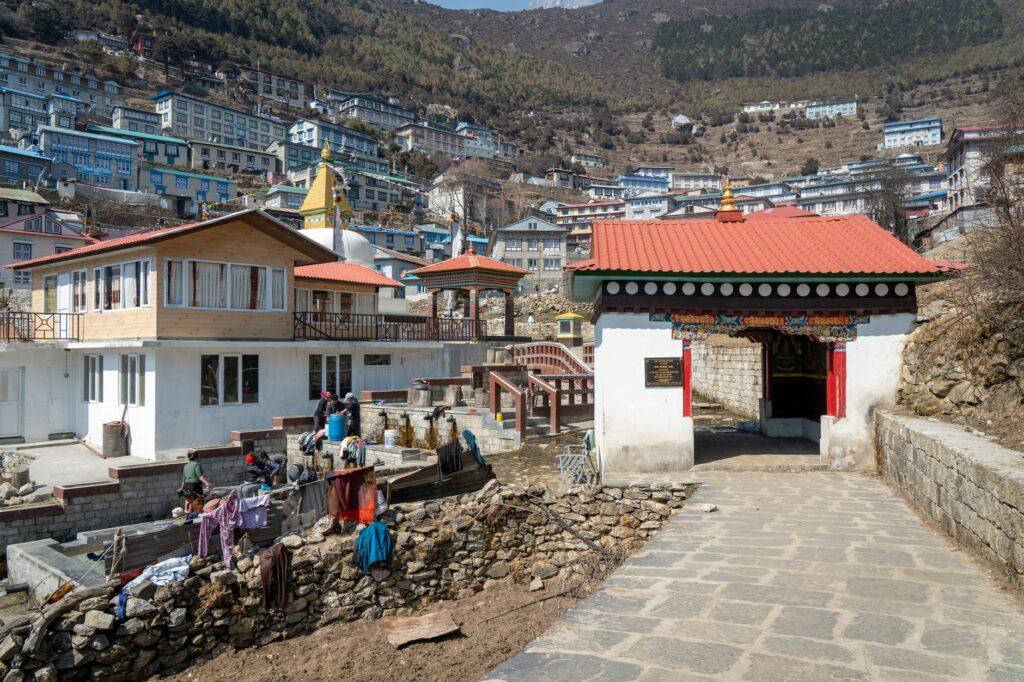
Namche Bazaar, a terraced town in the Khumbu region of Solukhumbu District, functions as the trading and administrative hub for Sherpa villages near Mount Everest. It sits at roughly 3,440 meters and has grown from a traditional trading post into a center for trekking logistics, lodges, and weekly markets.
Beyond Namche, villages such as Khumjung, Khunde, and Pangboche maintain a slower rhythm tied to farming potatoes and barley, herding yaks and dzopkyo (yak-cattle hybrids), and seasonal trade. Many families still move livestock between higher and lower pastures with the seasons, a practice called transhumance that has sustained Sherpa communities for generations.
Tourism has reshaped parts of the Khumbu, with teahouses and bakeries now common along popular routes. Travelers planning a visit often research the Everest Base Camp trek cost before setting out, since prices for permits, lodges, and guides vary by season and should be confirmed through the Nepal Tourism Board or a registered trekking agency.
Altitude is a serious consideration throughout the Khumbu. Trekkers should acclimatize gradually, watch for symptoms of altitude sickness such as headache, nausea, or dizziness, and travel with a licensed guide, since permits are required for trekking in the Sagarmatha National Park area, which falls under the Department of National Parks and Wildlife Conservation.
Sherpa marriage customs traditionally involve a multi-stage process that can include a period of engagement, a formal wedding ceremony, and sometimes a period of cohabitation before a union is considered fully settled. Families play an active role, though love matches are increasingly common alongside more traditionally arranged unions.
Sherpa society is organized into clans, and marrying within certain close clan lines is traditionally discouraged. Some older accounts describe historical cases of polyandry, where one woman married multiple brothers to keep family land undivided, though this practice is now rare and not representative of most Sherpa marriages today.
Extended families often live close together, and children are raised with strong ties to both immediate relatives and the wider village community. Inheritance customs and household responsibilities vary by family, but hospitality toward guests and respect for elders remain consistent values across Sherpa villages.
Mani Rimdu is the most significant Sherpa festival, a multi-day Buddhist celebration held at monasteries including Tengboche, featuring masked dances performed by monks that reenact the triumph of Buddhism over older beliefs. Because it follows the lunar calendar, the exact dates shift each year, typically falling in autumn, so travelers should check with monasteries or the Nepal Tourism Board for current timing.
Other important occasions include Losar, the Sherpa and Tibetan New Year, usually celebrated in winter with family gatherings, feasting, and the renewal of prayer flags. Dumje is another community festival, centered on prayers for the well-being and prosperity of the village, often involving collective feasting organized by rotating host families.
| Festival | Significance | Typical Timing |
|---|---|---|
| Mani Rimdu | Masked monastic dances symbolizing Buddhism’s triumph over earlier beliefs | Autumn (lunar calendar, varies yearly) |
| Losar | Sherpa and Tibetan New Year, family reunions and renewal rituals | Winter (lunar calendar, varies yearly) |
| Dumje | Village-wide prayers for health and prosperity | Summer (lunar calendar, varies yearly) |
These festivals are living traditions, not performances staged for visitors, though respectful tourists are often welcome to observe from the edges of monastery courtyards.
Sherpas are renowned for high-altitude climbing partly because generations of life above 3,000 meters have shaped real physical adaptations to low oxygen, combined with deep generational knowledge of mountain terrain and weather patterns. Scientists who study high-altitude populations have found that Sherpas and other Himalayan communities tend to use oxygen more efficiently than lowland populations, though the exact biological mechanisms are still being researched.
Since the first successful summit of Mount Everest in 1953 by Tenzing Norgay, an ethnic Sherpa, and Sir Edmund Hillary, Sherpas have played an essential role in nearly every major expedition in the region, from fixing ropes and carrying loads to guiding and managing high-altitude camps. For many Sherpa families, mountaineering work is a source of pride and income, but it also carries real risk, and the community has experienced tragic losses during accidents on Everest over the decades.
For a deeper look at the mountain itself, including its official measured height of 8,848.86 meters determined jointly by Nepal and China in 2020, see this collection of Mount Everest facts. Climbing is one profession among many for Sherpas, not a definition of who they are as a people.
The Sherpa people are far more than expedition support staff — they are a Himalayan ethnic community with their own language, Buddhist spiritual life, distinctive dress, and village traditions that continue in Solukhumbu today. Visiting the Khumbu with curiosity and respect, rather than assumptions, opens the door to a richer understanding of the region than the mountaineering headlines usually offer.
Travelers planning a trip to Namche Bazaar, Tengboche, or the Everest region are encouraged to learn a few words of greeting, observe monastery etiquette, and ask questions with genuine interest. Share your own experiences or questions about Sherpa culture and the Khumbu region in the comments below — real stories from the trail are always welcome.
The Sherpa people are a Tibetan-origin ethnic group who settled in the high valleys of northeastern Nepal, mainly in Solukhumbu District near Mount Everest, several centuries ago. They have their own language, Buddhist traditions, and village-based way of life distinct from the mountaineering roles many associate with the name.
Sherpa is primarily an ethnic identity, not a job. The word is often used informally for mountain guides because many Sherpas historically worked in high-altitude guiding, but most Sherpas work in farming, trade, education, and other fields unrelated to climbing.
Most Sherpas practice Tibetan Buddhism, specifically the Nyingma school. Their religious life includes monasteries called gompas, prayer flags, mani walls, and festivals such as Mani Rimdu, all of which shape daily routines and the yearly calendar in Sherpa villages.
The main traditional garment is the chuba, a wool wrap-style robe worn by both men and women. Women often pair it with a striped apron called a pangden, which traditionally signals marriage. Traditional dress today is mainly worn during festivals and ceremonies rather than daily life.
Sherpas are known for high-altitude climbing because generations of living above 3,000 meters have produced genuine physical adaptations to low oxygen, combined with inherited knowledge of mountain terrain. Their prominent role began with Tenzing Norgay’s participation in the first successful Everest summit in 1953.
No, this is a common misconception. Most Sherpas work as farmers, traders, lodge owners, teachers, or monks, and many have no connection to mountaineering at all. Guiding and portering are important but represent only one part of the Sherpa economy.
Featured image: Photo by Clinton Weaver on Pexels

Airports in Nepal: The Complete Tourist Guide (2026 Updated) Nepal has 55 airports in total, but as a tourist, […]
How Nepal Chooses a Living Goddess The five stages of selecting the Royal Kumari of Kathmandu […]
Nepal Travel Cost Per Day: A Real Budget Guide (2026) Travel & Tourism · Budget Guide 2026 Budget · […]
Nepalfacts 10 minutes read 20 views Explore Newar people traditions: Nepal Bhasa language, Hindu-Buddhist identity, Haku Patasi dress, Yomari feasts and Kathmandu Valley’s temple-building legacy.