Nepal Travel Cost Per Day: A Real Budget Guide
Nepal Travel Cost Per Day: A Real Budget Guide (2026) Travel & Tourism · Budget Guide 2026 Budget · […]
 Nepalfacts 09 minutes read 2 views
Mount Everest gets most of the attention, and the flag trivia shows up in nearly every listicle about Nepal. But Nepal’s real claim to fame runs deeper than a mountain and a shape. From its political history to the creatures living only in its high valleys, Nepal holds a surprising number of genuine “onlys” and world records that most travel articles never mention.
So what is Nepal the only country in the world to have? Among well-established claims: Nepal is the only nation with a non-rectangular national flag, the only former Hindu kingdom to peacefully transform into a secular republic, and home to the Kali Gandaki Gorge, widely cited as one of the deepest gorges on Earth. Nepal also hosts a living religious tradition found nowhere else.
Nepal’s distinctiveness comes from a rare combination: it sits wedged between two giants, India and China, yet was never formally colonized by a foreign power. That geographic and political position let Nepal develop its own flag shape and cultural institutions, like the Kumari tradition, that evolved without major colonial interruption.
Unlike most “unique facts” lists that lean on Everest’s height or Kathmandu’s temples, the claims below are specific, checkable superlatives — cases where Nepal is verifiably the only example or a genuine record holder. Each one comes with context on how it compares elsewhere, so the claim holds up to scrutiny.
Yes. Nepal was the world’s only officially declared Hindu kingdom until 2008, when the country ended its centuries-old monarchy and became the Federal Democratic Republic of Nepal. No other nation has held that specific constitutional status of a Hindu state before transitioning to a secular republic.
The shift followed a decade-long Maoist insurgency and a mass people’s movement that pushed King Gyanendra to cede power. Nepal’s constituent assembly formally abolished the monarchy in 2008, and the country became secular under its 2015 constitution, even though most of the population remains Hindu. Other countries, such as India, have large Hindu populations but have never been constitutionally defined as Hindu kingdoms, which is what makes Nepal’s political history a genuine first.
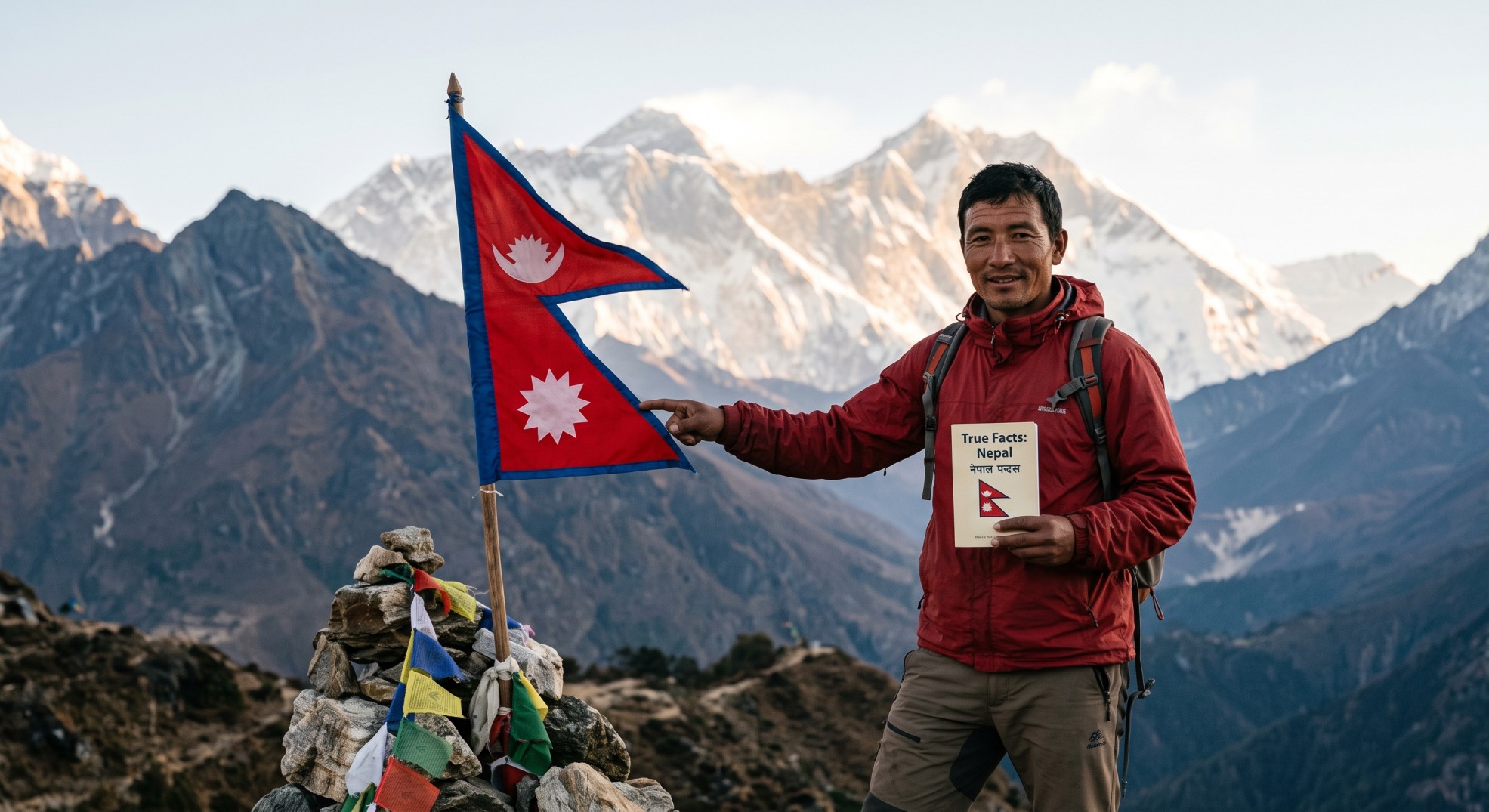
Nepal’s national flag is the only one among all United Nations member states that is not rectangular or square. It consists of two stacked triangular pennants, representing the Himalayas and the country’s two major religious traditions, Hinduism and Buddhism.
The design has roots going back over a century and was standardized in its current form in 1962. Every other country on Earth uses a four-sided flag, which makes Nepal’s shape an easy but completely true answer to “what is Nepal the only country to have.” For the full backstory on the design’s origins and symbolism, see this detailed explanation of why Nepal’s flag is not rectangular.
Nepal holds several genuine geographic superlatives beyond Mount Everest, including one of the world’s deepest gorges and some of the fastest-rising mountains on the planet. These records sit mainly in Nepal’s mountainous Gandaki and Koshi Provinces.
Anyone trekking near these regions, especially around the Annapurna or Everest Base Camp routes, should watch for symptoms of altitude sickness at higher elevations, ascend gradually, and trek with a licensed guide. Permits from Nepal’s Department of National Parks and Wildlife Conservation are required for these protected areas, and rules change, so check current requirements before you go.
Nepal’s Himalayan ecosystems host several notable species, thanks to isolated high-altitude valleys that function like evolutionary islands. The red panda, snow leopard, and Himalayan tahr all depend on Nepal’s mountain habitats, though none are exclusive to Nepal since their ranges extend into neighboring countries as well.
What is genuinely endemic — meaning found only within Nepal’s borders — includes certain alpine plant species and localized amphibians documented in isolated valleys of districts like Mustang and Dolpa in Gandaki Province. Researchers continue to study Nepal’s less-explored high-altitude zones, and agencies like the Department of National Parks and Wildlife Conservation monitor these populations.
A common misconception is that the snow leopard or red panda are unique to Nepal. Both species actually range across the broader Himalayan and Tibetan Plateau region, including parts of India, Bhutan, and China, so calling them “Nepal-only” overstates the claim.
Nepal is home to the Kumari tradition, a living goddess worshipped in the Kathmandu Valley, a practice with no direct equivalent anywhere else in the world. A young girl, chosen through a selection process rooted in Newar Buddhist and Hindu traditions, is honored as a living incarnation of the goddess Taleju until she reaches puberty.
Nepal is also frequently cited by historians as a country that was never formally colonized, despite intense pressure from British India during the 19th century. That status shaped much of Nepal’s legal system, calendar, and architecture, since it never underwent the administrative overhaul that colonization typically brings. You can read the fuller history of how this happened in this piece on why Nepal was never colonized.
Another frequent point of confusion involves Buddha’s birthplace. Siddhartha Gautama, who became the Buddha, was born in Lumbini, in present-day Rupandehi District, Lumbini Province, Nepal — not in India, as many assume. Lumbini is recognized by UNESCO as a World Heritage Site, and archaeological evidence, including an ancient pillar associated with Emperor Ashoka, supports the location.
Not every viral “only in Nepal” claim holds up to scrutiny, and some popular ones are exaggerated or false. Claims that momo or chiya (sweet milk tea) originated exclusively in Nepal are misleading, since both have shared origins across the broader Himalayan, Tibetan, and South Asian regions.
Momo most likely reached Nepal through Tibetan trade routes, and chiya-style milk tea is common across South Asia under different names. Nepal has developed its own distinct versions and flavors of both, but calling either dish a Nepal-only invention oversells the claim. For a broader rundown of commonly repeated inaccuracies, see this list of common myths about Nepal.
What most people get wrong is treating every “Nepal is the only country that…” claim as equally solid. Some, like the flag shape and the Hindu-kingdom-to-republic transition, are well-documented and essentially indisputable. Others, like species exclusivity or food origins, need qualifiers because neighboring countries share overlapping history, geography, or biology.
| Claim | Status | Location/Context |
|---|---|---|
| Only non-rectangular national flag | Verified | National symbol, standardized 1962 |
| Only former Hindu kingdom turned secular republic | Verified | Monarchy ended 2008; secular since 2015 constitution |
| Highest mountain above sea level (Mount Everest) | Verified | Sagarmatha National Park, Koshi Province |
| One of the deepest gorges (Kali Gandaki) | Widely cited, measurement methods vary | Gandaki Province, between Dhaulagiri and Annapurna |
| Living goddess tradition (Kumari) | Verified, unique practice | Kathmandu Valley, Bagmati Province |
| Never formally colonized | Widely accepted by historians | Entire country, through 19th-20th century |
| Birthplace of Buddha | Verified | Lumbini, Rupandehi District, Lumbini Province |
| Only country where momo/chiya originated | Myth / overstated | Shared Himalayan and South Asian origins |
| Only habitat of red panda/snow leopard | Myth / overstated | Species range across Himalayan region, not Nepal alone |
Nepal does not need borrowed or exaggerated claims to stand out. A non-rectangular flag, a Hindu-kingdom-to-republic transformation found nowhere else, the world’s highest peak, a living goddess tradition, and the actual birthplace of the Buddha are enough to make the country one of the most distinctive on Earth. The key is knowing which claims are solid and which ones need a qualifier.
If you are planning a trip or simply curious about what makes Nepal distinctive, there is always more to learn beyond the usual trivia. Share which of these facts surprised you most in the comments, or tell us what other “only in Nepal” claims you have heard and want fact-checked.
Nepal is the only country with a non-rectangular national flag and the only former Hindu kingdom to peacefully become a secular republic. It is also home to the Kumari, a living goddess tradition with no direct equivalent anywhere else in the world.
Yes, Nepal is the only United Nations member state with a national flag that is not rectangular or square. The flag consists of two stacked triangular pennants symbolizing the Himalayas and the country’s major religious traditions.
Nepal held the official status of a Hindu kingdom until its monarchy ended in 2008, making it the only country ever constitutionally defined that way. It later adopted secularism under its 2015 constitution while retaining a Hindu-majority population.
The Kali Gandaki Gorge in Nepal is widely cited as one of the deepest gorges on Earth when measured from surrounding peaks like Dhaulagiri and Annapurna. Some sources dispute exact rankings depending on measurement methods, so it is best described as among the deepest rather than an undisputed record.
Beyond Everest, Nepal is known for being the birthplace of Buddha in Lumbini, its never-colonized history, the Kumari living goddess tradition, and its one-of-a-kind triangular flag. It also holds a unique political history as the only Hindu kingdom turned secular republic.
The Kumari tradition, where a young girl is worshipped as a living goddess in the Kathmandu Valley, exists only in Nepal. Certain endemic alpine plants and amphibians in isolated valleys like Mustang and Dolpa are also found nowhere else.

Nepal Travel Cost Per Day: A Real Budget Guide (2026) Travel & Tourism · Budget Guide 2026 Budget · […]
Nepalfacts 10 minutes read 62 views Discover Sherpa people traditions beyond the climbing stereotype — Tibetan origins, Buddhist faith, dress, marriage customs, and village life in Khumbu.
Nepalfacts 05 minutes read 292 views Why Is Nepal’s Population Growing Slower Than You’d Think? Facts of Nepal · Demographics Why Is Nepal’s Population Growing […]
Myths to Stop Repeating ❌ “Nepal has 10 UNESCO World Heritage Sites.” ✅ Nepal has 4 inscribed properties: Kathmandu […]