

Federal Democratic Republic Of Nepal
Federal Democratic Republic of Nepal: Facts, History & Government (2026) Nepal Facts · Updated 2026 Federal Democratic Republic of […]
 Nepalfacts 10 minutes read 20 views
Few women from Nepal’s ancient past are as celebrated, and as debated, as Bhrikuti. She appears in Tibetan religious history as a queen who helped introduce Buddhism to the Tibetan plateau, yet she is barely mentioned in the surviving stone inscriptions of her own homeland. So who was Bhrikuti, the Nepali princess credited with changing Tibet’s religious direction? She was most likely a Licchavi-era princess from the Kathmandu Valley who, according to long-standing tradition, married the Tibetan emperor Songtsen Gampo around the 7th century CE, becoming one of the earliest symbols of cultural and diplomatic ties between Nepal and Tibet.
Bhrikuti, sometimes called Bhrikuti Devi, is remembered in tradition as a daughter of a Licchavi king of Nepal who was sent to Tibet to marry Songtsen Gampo, the ruler who unified much of the Tibetan plateau in the early 600s CE. Tibetan Buddhist tradition treats her as a central figure in Tibet’s conversion to Buddhism, alongside the Tang Chinese princess Wencheng.
Nepali and Tibetan sources do not fully agree on details such as her exact birth date, her father’s identity, or the year she traveled to Tibet. Historians generally separate two layers in her story: a plausible historical core, a Licchavi princess married into Tibet’s royal house for political reasons, and a devotional layer added over centuries by Tibetan Buddhist writers who wanted to honor her as a near-divine figure.
The Licchavi dynasty ruled the Kathmandu Valley from roughly the 4th to the 9th century CE and is remembered as one of Nepal’s most culturally productive periods, known for stone inscriptions, temple building, and active trade links. Licchavi kings left behind inscriptions in Sanskrit recording land grants and religious donations, giving historians a rare direct window into early Nepali governance.
During this era, the Kathmandu Valley sat on a trade corridor between the Indian subcontinent and Tibet, making it a natural meeting point for merchants, pilgrims, and diplomats. Marriage alliances with neighboring powers were a recognized diplomatic tool of the period, a pattern later Nepali rulers would also use alongside conquest, as seen in the unification campaigns of Prithvi Narayan Shah centuries afterward.
It is within this context, an outward-looking Licchavi state with active regional ties, that a royal marriage between the Kathmandu Valley and Tibet becomes historically plausible rather than purely legendary.
Tradition holds that Songtsen Gampo sought a marriage alliance with a Nepali princess to strengthen trade routes and build ties with a culturally established neighboring kingdom. Tibet in the early 7th century was rapidly expanding, and marriage diplomacy with both Nepal and Tang China allowed the Tibetan court to connect with two important centers of Buddhist and administrative learning.
From Nepal’s side, the Kathmandu Valley offered access to skilled artisans, Buddhist scriptures, and Newar craftsmanship, valuable resources for a Tibetan court interested in building monasteries and establishing religious legitimacy. A marriage tied to a Licchavi princess also connected Tibet symbolically to the Buddhist and Hindu traditions already established in the valley.
Tibetan chronicles describe Bhrikuti traveling from the Kathmandu Valley to Lhasa to marry Songtsen Gampo, bringing with her Buddhist images, texts, and craftsmen. These chronicles were composed mostly centuries after the events they describe and blend devotional storytelling with historical memory, which makes it hard to separate factual detail from later embellishment.
According to tradition, Bhrikuti is credited with encouraging the construction of the Jokhang Temple in Lhasa, one of Tibetan Buddhism’s most sacred sites, said to have been built in part to house a Buddha image she brought from Nepal. Whether she personally oversaw construction or simply inspired it through her presence at court is not something modern historians can confirm with certainty.
What can be said plainly is that her story, likely true in outline even if uncertain in detail, reflects a real historical pattern: Himalayan royal marriages that carried religious objects, artisans, and ideas along with the bride.
Bhrikuti’s traditionally credited contribution to Tibetan Buddhism lies less in doctrine and more in patronage, bringing artisans, religious images, and Newar architectural styles said to have shaped early Tibetan Buddhist temples. Buddhism in Tibet before the 7th century had limited royal support, and the arrival of two Buddhist queens at Songtsen Gampo’s court is traditionally viewed as encouraging the throne’s interest in the religion.
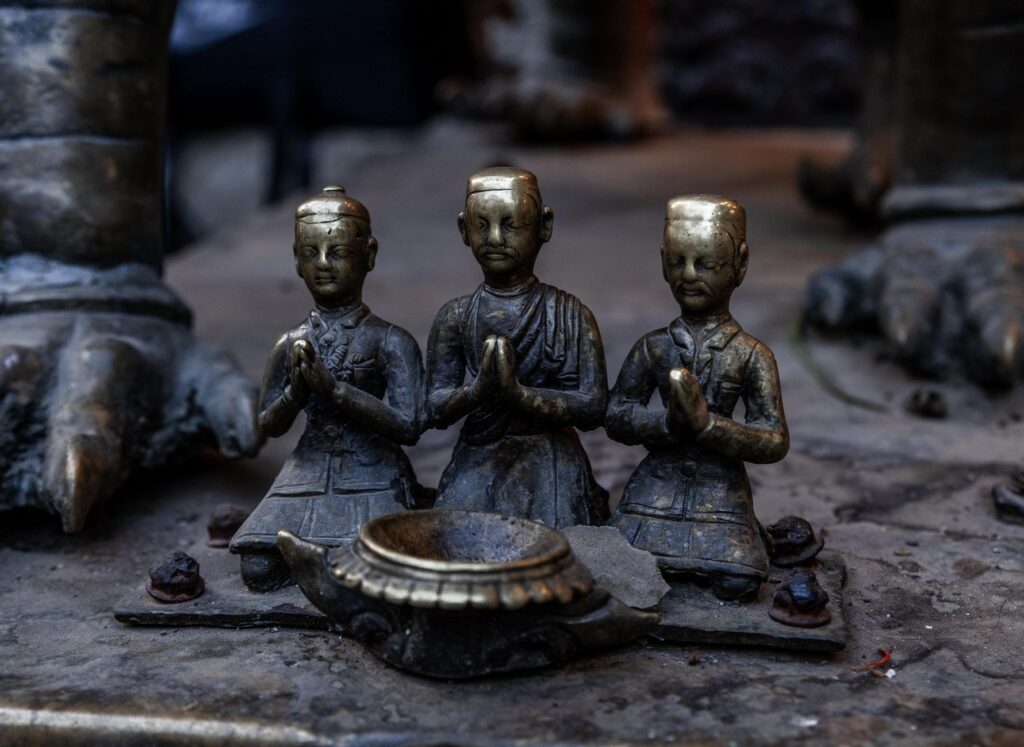
Newar craftsmen from the Kathmandu Valley, the same community long credited with shaping much of Nepal’s religious art, are traditionally linked to early Tibetan temple construction through this period of exchange. Nepal’s artistic influence on early Tibetan Buddhism is widely acknowledged, even where specific credit to Bhrikuti herself is harder to verify from independent sources.
Songtsen Gampo’s own ministers and later Buddhist missionaries also played important roles in establishing Buddhism in Tibet, so Bhrikuti’s traditional influence is best understood as part of a broader royal and cultural effort, not a solo achievement.
In Tibetan Buddhist tradition, Bhrikuti is venerated as an incarnation of Green Tara, a bodhisattva associated with compassion and swift help, while Princess Wencheng is linked to White Tara. This pairing elevated both queens from historical figures into objects of religious devotion within Tibetan Buddhism.
The Green Tara association reflects a broader pattern in South and Central Asian religious history, where respected queens or holy women were later identified with established deities to reinforce their spiritual importance. This does not necessarily mean the historical Bhrikuti claimed divine status herself; later generations of Tibetan Buddhists came to see her life as an expression of Tara’s compassionate activity in the world.
This devotional elevation is part of why Bhrikuti’s story can feel more mythical than historical in many retellings, even though a real diplomatic marriage likely sits at its core.
Direct, independent historical proof of Bhrikuti’s existence is limited, since surviving Licchavi-era Nepali inscriptions do not clearly name her, and most detailed accounts come from later Tibetan Buddhist chronicles. This gap sits at the center of scholarly debate: her story is widely accepted as tradition, but it cannot be confirmed with the same documentary certainty as the Licchavi land-grant inscriptions that do survive.
Historians generally take a middle position. They accept that a Nepal-Tibet royal marriage in the 7th century is plausible and consistent with diplomatic patterns of the era, while acknowledging that specific details about Bhrikuti, her parentage, exact dates, and personal actions, rely on sources written well after her lifetime.
| Aspect | What Tradition Says | What Historical Evidence Shows |
|---|---|---|
| Her existence | A real Licchavi princess sent to Tibet | Plausible, but not confirmed by contemporary Nepali inscriptions |
| Marriage to Songtsen Gampo | Described in detail in Tibetan chronicles | Consistent with the broader pattern of Nepal-Tibet diplomatic marriages |
| Role in Buddhism’s spread | Credited with founding temples and bringing scriptures | Consistent with known Newar artistic influence on early Tibetan Buddhism |
| Green Tara identity | Accepted as religious truth in Tibetan Buddhism | Understood by historians as later devotional symbolism |
Bhrikuti’s legacy in Nepal survives mainly through Licchavi-era temples, Newar Buddhist art traditions, and the living craft culture of the Kathmandu Valley, rather than through a single preserved monument built in her honor. The valley’s dense concentration of Licchavi and later Malla-period temples offers the closest physical link to the world she would have known.
Visitors interested in her story can explore:
These sites sit within the living culture of the Newar people of Kathmandu Valley, whose festivals, temple art, and craftsmanship carry Licchavi-era traditions into the present day. No statue or temple in the Kathmandu Valley is widely recognized as being dedicated specifically to Bhrikuti, so her legacy is best understood through this broader cultural inheritance rather than a single pilgrimage site.
If you plan to combine this history with high-altitude travel elsewhere in Nepal, remember that trekking above 3,000 meters carries a real risk of altitude sickness. Travelers should acclimatize gradually, consider hiring a licensed guide, and arrange any required permits through the Nepal Tourism Board or Department of National Parks and Wildlife Conservation.
Bhrikuti’s story sits at the meeting point of history and devotion: a Licchavi princess whose marriage to Songtsen Gampo, according to long tradition, helped tie Nepal and Tibet together through trade, art, and religion, even if some details remain impossible to verify. Her life, legendary or historical in its particulars, reflects a significant chapter of Nepal’s past, when the Kathmandu Valley stood at the center of Himalayan diplomacy and Buddhist exchange.
Travelers drawn to this era of Nepali history will find plenty more to explore, from the courtyards of Patan to later turning points in Nepal’s story, including the political shifts of the Kot Massacre and the rise of the Rana dynasty. Share your own thoughts or questions about Bhrikuti and Nepal’s Licchavi heritage in the comments, and consider planning a visit to the Kathmandu Valley to see where this history still lives today.
Historians believe Bhrikuti likely represents a real Licchavi princess who married into Tibet’s royal family, since such alliances fit the diplomatic patterns of the 7th century. However, independent Nepali inscriptions from her supposed lifetime do not clearly confirm her, so most detail comes from later Tibetan Buddhist sources.
Songtsen Gampo was the Tibetan emperor who unified much of the Tibetan plateau in the early 600s CE and is traditionally credited, alongside his queens, with encouraging Buddhism’s early growth in Tibet. He is also remembered for marriage alliances with both Nepal and Tang China.
Tibetan Buddhist tradition identifies Bhrikuti as an incarnation of Green Tara, a bodhisattva linked to compassion and swift help, while Princess Wencheng of China is linked to White Tara. This devotional identity was added by later generations to honor her role in spreading Buddhism, rather than being a claim she made herself.
No single monument in Nepal is dedicated specifically to Bhrikuti. Visitors can instead explore Licchavi-era temples and inscriptions in Kathmandu, Patan, and Bhaktapur, along with Newar Buddhist monasteries and Patan’s historic metalwork district, which reflect the artistic world connected to her era.
The Licchavi dynasty ruled the Kathmandu Valley from roughly the 4th to the 9th century CE and is known for Sanskrit stone inscriptions, early temple architecture, and active trade with neighboring regions including Tibet and the Indian subcontinent. It is considered a formative period in Nepal’s cultural history.
Featured image: Photo by Roman Saienko on Pexels

Federal Democratic Republic of Nepal: Facts, History & Government (2026) Nepal Facts · Updated 2026 Federal Democratic Republic of […]
Nepalfacts 09 minutes read 59 views Red panda Nepal guide: where these rare “firefoxes” live, your realistic odds of spotting one, and the best trekking routes in Ilam, Taplejung and Langtang.
Facts of Nepal · Language How Many Languages Does Nepal Actually Speak? Hint: it’s a lot more […]
Nepalfacts 09 minutes read 50 views Discover weird laws in Nepal, from cow protection rules to temple etiquette, so you can travel respectfully and avoid awkward mistakes.