Comments Off on Snow Leopard Nepal: Where the Ghost of the Mountains Lives
Key Takeaways
Nepal is thought to host roughly 300 to 400 snow leopards living in high-altitude regions above 3,000 meters, mainly in Dolpo, Mustang, Manang, and Kanchenjunga.
Direct sightings of snow leopards are extremely rare even for experienced trekkers, who more commonly find tracks, scat, or camera-trap images instead.
Shey Phoksundo National Park in Dolpo and the Annapurna Conservation Area in Mustang and Manang are Nepal’s best-documented snow leopard habitats.
Snow leopards are classified as Vulnerable by the IUCN, and Nepal protects them through national parks, community-based livestock insurance schemes, and anti-poaching patrols.
Treks into snow leopard territory require restricted-area permits and careful altitude acclimatization, since all key routes lie above 3,500 meters.
Picture a creature so elusive that wildlife researchers can spend entire careers in the Himalayas without ever seeing one in the wild. That is the reality of the snow leopard in Nepal. Snow leopards do live in Nepal, roaming the high, cold wilderness above 3,000 meters along the northern border with Tibet, and this guide covers where they live, how rare they truly are, and what your realistic odds of spotting one actually look like.
Are Snow Leopards Really Found in Nepal?
Snow leopards (Panthera uncia) are confirmed residents of Nepal’s high Himalaya, living in the remote trans-Himalayan zones of the far north. These areas sit in rain-shadow regions where the terrain turns to open rocky steppe and alpine scrub, similar to the Tibetan Plateau just across the border.
Nepal’s snow leopard habitat spans districts in Karnali, Gandaki, and Koshi provinces near the Tibet border, covering a large stretch of high-altitude terrain. This is not jungle big-cat country like Chitwan; it is bare, wind-scoured mountain terrain above the tree line, generally between 3,000 and 5,400 meters elevation.
Why Is It Called the ‘Ghost of the Mountains’?
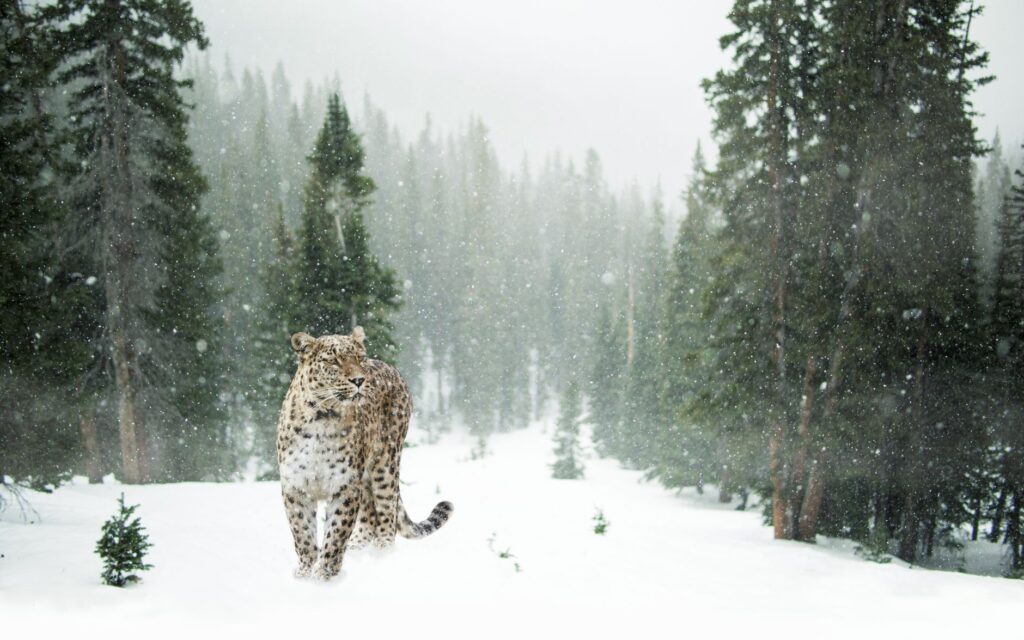
The snow leopard earned the nickname “Ghost of the Mountains” because of its pale, rosette-covered coat, solitary habits, and ability to vanish into rocky cliffs the moment it senses a human nearby. Even researchers using camera traps for years may never see one directly in the wild.
Its camouflage is so effective against snow, scree, and granite outcrops that local herders in Dolpo and Mustang often confirm a snow leopard’s presence only through fresh pugmarks, scat, or a missing livestock animal, rather than an actual sighting. This elusiveness is also a survival strategy: as an ambush predator of blue sheep (locally called naur) and Himalayan tahr, the cat depends on staying unseen until the final pounce.
How Many Snow Leopards Live in Nepal Today?
Nepal is estimated to host somewhere between 300 and 400 snow leopards, based on surveys and camera-trap work carried out by the Department of National Parks and Wildlife Conservation together with conservation partners. This figure is an estimate rather than an exact census, since the species’ habitat is vast, remote, and difficult to survey consistently.
Globally, snow leopards are classified as Vulnerable by the International Union for Conservation of Nature (IUCN). Population estimates across their Asian range vary widely between sources and are considered rough approximations rather than a precise count. Nepal’s population, while modest in absolute terms, makes the country one of the significant range states for the species’ long-term survival.
Where to See Snow Leopards in Nepal: Top Regions and Conservation Areas
The best-documented snow leopard habitats in Nepal are Dolpo, Mustang, Manang, and the Kanchenjunga region, all within established conservation areas or national parks. Each offers a different mix of scenery, trekking infrastructure, and realistic wildlife-viewing expectations.
Shey Phoksundo National Park (Dolpo, Karnali Province): Nepal’s largest national park and one of the most important strongholds, home to the turquoise Phoksundo Lake and remote Tibetan Buddhist villages.
Annapurna Conservation Area (Manang and Mustang, Gandaki Province): Managed by the National Trust for Nature Conservation, this is Nepal’s largest protected area and includes the dry upper Mustang and Manang valleys where snow leopards share habitat with blue sheep.
Api Nampa Conservation Area and Kanchenjunga Conservation Area (far-west and east Nepal): Less-visited, rugged terrain bordering Tibet and India, with ongoing camera-trap monitoring programs.
Manaslu Conservation Area (Gorkha, Gandaki Province): A quieter alternative route with confirmed snow leopard sign in its upper reaches.
The Dolpo snow leopard population is relatively well studied because of the region’s large tracts of undisturbed habitat and lower human density compared with more popular trekking corridors. The Annapurna snow leopard range in upper Manang and Mustang has also benefited from long-running community-based conservation work.
What Are Your Realistic Chances of Spotting One?
Most travelers who visit snow leopard habitat in Nepal will encounter signs of the cat, such as pugmarks, scat, or scratch marks, rather than the animal itself. Direct sightings stay genuinely rare even for trekkers who spend weeks at high altitude in prime habitat.
Camera traps set by conservation researchers capture images far more often than any human eye does, since the cats are active mostly at dawn, dusk, and night, and their coloring blends into rocky slopes. A useful way to frame it: treat a snow leopard trek less as a guaranteed wildlife safari and more as a chance to walk through genuinely wild, high-altitude terrain where the species still survives, with any sighting a rare bonus rather than an expectation.
Specialized tracking trips, sometimes run with trained naturalists and local spotters in areas like Upper Dolpo during winter, can improve the odds somewhat, since cats occasionally move to lower elevations when snow covers their usual terrain. Even on these dedicated trips, reputable operators are upfront that sightings are never guaranteed.
How Is Nepal Protecting Its Snow Leopards?
Nepal protects snow leopards through a network of national parks and conservation areas, community-based anti-poaching efforts, and livestock insurance schemes that reduce retaliatory killing by herders. The Department of National Parks and Wildlife Conservation coordinates much of this work with non-government partners.
Key conservation strategies include:
Camera-trap monitoring to track population trends and movement corridors near the Nepal-Tibet border.
Community-based insurance funds that compensate herders for livestock losses, reducing incentives to kill snow leopards in retaliation.
Anti-poaching patrols aimed at the illegal trade in pelts and bones.
Cooperation with neighboring countries, since snow leopard territories often cross international borders.
Nepal also takes part in regional snow leopard conservation efforts alongside other range countries across Central and South Asia, reflecting the species’ status as a shared priority rather than a purely national one.
Snow Leopard vs Common Leopard: Key Differences
Snow leopards and common leopards are different species adapted to very different environments, and confusing the two is a common misconception among first-time visitors to Nepal. The table below highlights the main distinctions.
Feature
Snow Leopard
Common Leopard
Habitat in Nepal
High Himalaya, above 3,000 m (Dolpo, Mustang, Manang)
Mid-hills and lowland forests, including near Chitwan
Coat pattern
Pale grey with large rosettes, thick fur
Golden-yellow with smaller dark rosettes
Tail
Very long, thick, used for balance on cliffs
Shorter relative to body size
Typical prey
Blue sheep, Himalayan tahr, marmots
Deer, wild boar, small mammals
Vocalization
Cannot roar; makes softer calls
Can roar
Visitors heading to lowland parks like Chitwan National Park should not expect snow leopard sightings there; the Chitwan National Park safari guide covers the very different range of wildlife found in that subtropical lowland ecosystem, including common leopards, rhinos, and tigers.
Best Treks and Trips for Snow Leopard Habitat Encounters
The most promising treks for experiencing snow leopard habitat in Nepal are the Upper Dolpo trek, the Upper Mustang trek, and the Nar Phu Valley trek in Manang, all passing through high, dry terrain favored by the species. These routes require restricted-area permits in addition to standard conservation area fees, since they lie in sensitive border regions.
Upper Dolpo Trek: A long, remote journey through Shey Phoksundo National Park, often considered the single best region in Nepal for snow leopard habitat.
Upper Mustang Trek: Follows ancient trade routes through the former Kingdom of Lo, with dramatic desert-like cliffs and monasteries.
Nar Phu Valley Trek: A quieter alternative near the Annapurna Circuit, passing through isolated villages rarely visited by mass tourism.
Kanchenjunga Base Camp Trek: A longer, less-crowded route in eastern Nepal with confirmed snow leopard sign at upper elevations.
Travelers interested in lower-altitude wildlife and birdlife as a complement to high-mountain trekking might also enjoy exploring Rara Lake; the guide on how to visit Rara Lake covers Nepal’s largest lake and the surrounding Rara National Park in the western hills. Those drawn to Nepal’s rarer mammals more broadly may also want to read about the red panda in Nepal, another elusive high-altitude species found in different, slightly lower forest zones than the snow leopard.
Altitude safety note: All of these treks involve sustained travel above 3,500 meters, where altitude sickness is a real risk. Trekkers should build in proper acclimatization days, hire a licensed guide, and arrange the required restricted area permits and conservation area entry fees through a registered trekking agency, since exact permit costs and rules change and should be confirmed with the Nepal Tourism Board or Department of Immigration before departure.
Exploring Nepal’s High-Altitude Wilderness
Nepal’s snow leopards remain a quiet, resilient presence in some of the most dramatic landscapes on Earth, from the cliffs of Dolpo to the windswept valleys of upper Mustang. Seeing one is mostly a matter of luck rather than planning, but walking through its territory, breathing that thin mountain air, and spotting a fresh pugmark in the snow is an experience few other places can offer. Share your own high-altitude trekking stories or questions in the comments below, and start planning your next journey into Nepal’s wild northern frontier.
Frequently Asked Questions
Are there snow leopards in Nepal?
Yes, snow leopards live in Nepal’s high Himalayan regions above roughly 3,000 meters, mainly along the northern border with Tibet. Confirmed populations exist in Dolpo, Mustang, Manang, and Kanchenjunga, all within established national parks or conservation areas managed to protect the species.
Where can you see a snow leopard in Nepal?
The best regions are Shey Phoksundo National Park in Dolpo, the Annapurna Conservation Area in upper Mustang and Manang, and the Kanchenjunga Conservation Area in eastern Nepal. Even in these areas, sightings are rare; most visitors find tracks or scat rather than the animal itself.
How many snow leopards are left in Nepal?
Nepal is estimated to host between about 300 and 400 snow leopards, based on camera-trap surveys by the Department of National Parks and Wildlife Conservation and partner organizations. This is an estimate, since the vast and remote habitat makes an exact count difficult.
Can tourists actually spot a snow leopard in the wild?
Direct sightings are genuinely rare, even for trekkers spending weeks in prime habitat, because the cats are mostly active at dawn, dusk, and night and blend perfectly into rocky terrain. Most visitors should expect to see tracks or scat rather than the animal itself.
Is it dangerous to trek in snow leopard territory?
Snow leopards are shy of humans and attacks on people are essentially unheard of, so the animal itself poses little danger. The real risks on these treks come from high altitude and remote terrain, so proper acclimatization, licensed guides, and required permits matter more than wildlife encounters.
What’s the difference between a snow leopard and a regular leopard?
Snow leopards live in high, cold Himalayan terrain above 3,000 meters and have pale grey fur with large rosettes and a thick, long tail for balance on cliffs. Common leopards live in Nepal’s mid-hills and lowland forests, have golden-yellow coats, and can roar, unlike snow leopards.
Comments Off on Dal Bhat Nepal: The Story Behind the National Dish
Dal bhat nepal explained: what’s in the plate, why trekkers call it “power 24 hour,” regional variations, and the etiquette of eating it with your hands.




 Nepalfacts 10 minutes read 81 views