Standing at 5,364 meters beneath the world’s highest mountain is a dream shared by trekkers everywhere — and the first question almost everyone asks is the same: how much does it actually cost?
Search online and you’ll find quotes ranging from $999 to $5,000 for what looks like the same two-week trek. The truth is that the Everest Base Camp (EBC) trek cost in 2026 depends on how you travel, when you go, and what your package actually includes. This guide breaks down every expense — permits, flights, guides, food, gear, and the hidden costs nobody mentions — so you can budget with confidence, whether you’re flying in from New York, London, Sydney, or Delhi.
Everest Base Camp Trek Cost 2026: Quick Answer
Here’s the realistic price range per person for a 12–14 day trek in 2026:
| Trek Style |
Cost (USD) |
What’s Included |
| Budget / Independent |
$1,000 – $1,500 |
Permits, flights, teahouses, food (no guide/porter) |
| Standard Guided (local agency) |
$1,300 – $2,000 |
Guide, porter, permits, Lukla flights, lodging, meals |
| International Agency Package |
$1,700 – $3,000 |
Same as above, booked via overseas operator |
| Luxury / Helicopter Return |
$3,000 – $5,500+ |
Premium lodges, small groups, heli exit from Gorak Shep |
Bottom line: Most first-time trekkers should budget $1,800 – $2,200 all-in for a comfortable guided trek — including tips, insurance, gear rental, and a buffer for delays. That’s the real number, not the brochure number.
Cost Breakdown: Where Your Money Actually Goes
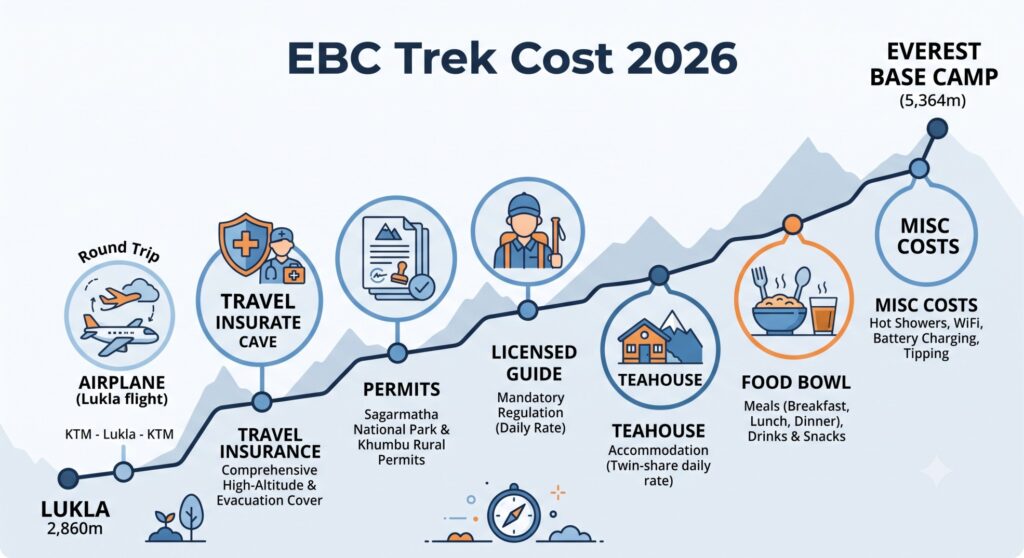
1. Trekking Permits ($40–$50)
Two permits are mandatory for the classic Lukla-to-EBC route in 2026:
- Sagarmatha National Park Entry Permit — roughly $30 (including VAT). Available in Kathmandu or at Monjo on the trail.
- Khumbu Pasang Lhamu Rural Municipality Permit — roughly $20. Purchased in Lukla or Monjo.
Good to know: The old TIMS card is no longer required for the standard EBC route via Lukla, so don’t let anyone charge you for it. SAARC nationals (including Indian trekkers) pay significantly discounted permit rates. Permit fees are set by the Nepal government and can change, so verify before departure.
2. Lukla Flights ($400–$480 round trip)
The short but famous flight to Lukla is the single biggest fixed cost of the trek. In 2026, foreign trekkers pay roughly $200–$240 one way, or around $400–$480 return.
During peak spring and autumn seasons, flights often depart from Ramechhap Airport (a 4–5 hour drive from Kathmandu) instead of Kathmandu itself, to ease air traffic. Ramechhap fares are slightly cheaper, but you’ll pay for road transport, so the total works out similar.
Budget tip: Lukla flights are weather-dependent. Keep 1–2 buffer days and a few hundred dollars aside for possible delays, extra hotel nights, or a helicopter alternative.
3. Guide and Porter ($350–$700 for the trek)
- Licensed guide: $25–$35 per day
- Porter (carries up to 20–25 kg, shareable between two trekkers): $18–$25 per day
Over a 12–14 day trek, hiring both typically adds $500–$700 — money well spent. A good guide manages teahouse bookings, monitors altitude symptoms, and solves problems when things go wrong at 5,000 meters. Note that Nepal has strengthened rules encouraging guided trekking in recent years, and many teahouses in peak season prioritize guided groups.
4. Accommodation ($3–$10 per night in teahouses)
Basic teahouse rooms cost just $3–$5 per night at lower elevations, rising to around $10 at Gorak Shep, the final stop before Base Camp. The catch? Teahouses expect you to eat where you sleep — that’s where they make their money. Luxury lodges (available at select stops) run $60–$120+ per night.
5. Food and Water ($25–$40 per day)
Food prices climb with altitude, because everything is carried up by porters or yaks:
- Dal bhat (the trekker’s staple — unlimited refills!): $5–$10
- Breakfast items, pasta, momos: $4–$8
- Bottled water: $1 at Lukla, up to $4–$5 near Base Camp
- Hot drinks: $2–$5
Over 12–14 days, expect $300–$500 total on food and drinks if meals aren’t included in your package.
Save money: Carry water purification tablets or a filter bottle instead of buying bottled water — you’ll save $50–$100 and reduce plastic waste on the trail.
6. Gear and Equipment ($150–$600)
If you’re starting from scratch, quality gear (boots, down jacket, sleeping bag, layers, poles) can cost $500–$1,000 to buy. The smarter option for most travelers: rent in Kathmandu’s Thamel district, where a sleeping bag or down jacket costs $1–$2 per day. Budget $150–$300 for a mix of renting and buying essentials.
7. Travel Insurance ($100–$180)
Non-negotiable. Your policy must cover trekking up to 6,000 meters and helicopter evacuation, which can cost $5,000+ out of pocket without insurance. Expect $100–$180 for a two-week high-altitude policy.
8. Nepal Visa ($30–$50)
Available on arrival at Kathmandu airport for most nationalities:
- 15 days: $30
- 30 days: $50 (recommended — it covers flight delays)
- 90 days: $125
9. Tips, Wi-Fi, Charging, and Hot Showers ($150–$250)
The hidden costs that crack budgets:
- Tips: Customary and expected — roughly $80–$150 combined for guide and porter for the trek
- Device charging: $2–$5 per charge at higher teahouses (bring a power bank)
- Wi-Fi: $3–$5 per day where available
- Hot showers: $3–$6 each above Namche Bazaar
Sample Budget: 14-Day Guided EBC Trek (2026)
| Expense |
Cost (USD) |
| Guided package (guide, porter, permits, flights, lodging, meals) |
$1,400 – $1,800 |
| Nepal visa (30 days) |
$50 |
| Travel insurance |
$130 |
| Gear rental/purchase |
$200 |
| Tips for guide & porter |
$120 |
| Extras (Wi-Fi, charging, showers, snacks) |
$150 |
| Buffer for delays |
$150 |
| Total (excluding international flights) |
$2,200 – $2,600 |
International airfare varies widely by region — roughly $600–$1,400 from Europe or North America, $700–$1,200 from Australia, and $150–$300 (₹15,000–₹25,000) from major Indian cities.
When Is the Cheapest Time to Trek EBC?
- Peak season (March–May, October–November): Best weather, biggest crowds, highest teahouse prices.
- Shoulder months (early March, late November): Great value — decent conditions, lower prices, fewer trekkers.
- Off-season (December–February, June–August): The cheapest window, sometimes $200–$400 less. Winter brings crystal-clear views but brutal cold; monsoon brings lush valleys but rain and flight delays.
7 Proven Ways to Cut Your EBC Trek Cost
- Join a group departure instead of a private trek — saves $200–$400 for the same route.
- Book with a registered local Nepali agency rather than an international reseller — often 20–40% cheaper for equivalent service.
- Share a porter with a trekking partner.
- Rent gear in Kathmandu instead of buying at home.
- Eat dal bhat — it’s filling, cheap, and refillable.
- Purify your own water instead of buying bottles.
- Trek in shoulder season for lower prices and quieter trails.
One warning: never cut costs on your guide, insurance, or acclimatization days. The cheapest quote is rarely the cheapest trek — an unsafe itinerary or a helicopter evacuation will cost far more than you saved.
Is the Everest Base Camp Trek Worth the Cost?
Absolutely — for most trekkers, it’s the adventure of a lifetime. For roughly the price of a week at a beach resort, you get two weeks walking through Sherpa villages, ancient monasteries, and glacier valleys, ending at the foot of the highest mountain on Earth. Few travel experiences deliver more per dollar.
FAQs: Everest Base Camp Trek Cost 2026
How much does the Everest Base Camp trek cost in 2026? Between $1,000 and $5,000 per person depending on style. A standard guided 14-day trek with a local agency costs $1,300–$2,000, while a realistic all-in budget is $1,800–$2,200.
Can I trek to EBC without a guide? The classic route can technically be done independently for $1,000–$1,500, but regulations and teahouse availability increasingly favor guided trekkers, and a guide dramatically improves safety at altitude. First-timers should hire one.
How much do EBC permits cost? Around $50 total: roughly $30 for the Sagarmatha National Park permit and $20 for the Khumbu municipality permit. TIMS is not required on this route.
How much cash should I carry on the trek? There are no reliable ATMs beyond Namche Bazaar. Carry $300–$500 in Nepalese rupees for food, drinks, charging, showers, and tips.
Is the trek cheaper for Indian trekkers? Yes. SAARC nationals get discounted permits, flights from India are short and affordable, and the favorable exchange rate helps. A full trip from India typically costs ₹1,50,000–₹2,50,000.
What’s the biggest hidden cost? Flight delays. Lukla’s weather can strand trekkers for days — always build buffer days and buffer money into your plan.
Prices in this guide reflect 2026 rates and are subject to change by the Nepal government and airlines. Always confirm current permit fees and flight prices before booking.


 Nepalfacts 11 minutes read 19 views